


3 Tips to get your stakeholders on board for brand building content
How to win the long-term brand versus the short-term sexy vanity campaign content battle
Having a hard time getting the budget and resources to create brand building content? You're not alone. Despite its increased importance, it's still not at the top of the priority list at the C-suite.
Especially in this AI era, showing your personality and your ‘why’, what sets you apart from others, matters. The more AI we get, the more we'll value authenticity. Right?
Still, it's hard to convince your stakeholders in the C-suite of the importance of continuously investing in this long-term, low ROI, and difficult-to-measure, brand-building content; here are a few pointers that might help.
- 60-40 brand building rule
- Essential for SEO
- Your content feeds AI
First this…
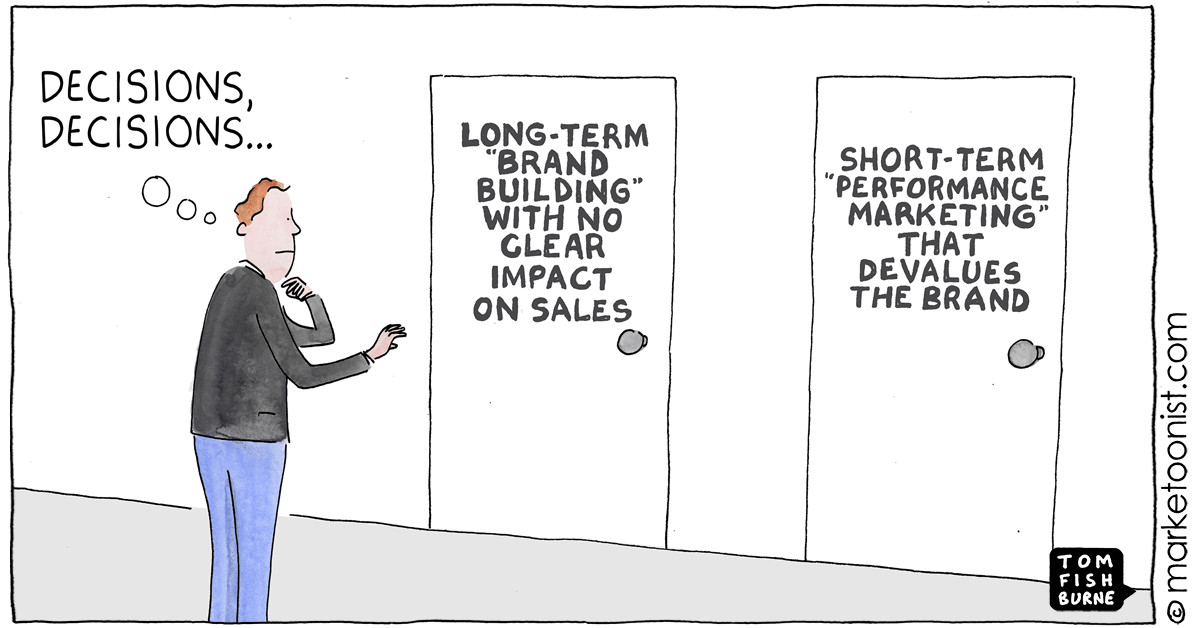
Before we start, I realize that your peers in the C-suite are not stupid, and they know this type of content is indispensable. Yet, because of a lack of immediate results and no sexy vanity metrics, it's hard to get the urgency across to free up the scarce resources and budget.
At best, you can squeeze in some of this content production on the side, but continuous love and care for this is very, very rare.
But, it's necessary. It's consistency over intensity. And if you give your brand building content some daily love and care, you might even appear to care. A nice side effect is that once you have your basic content, it's quite an easy job to keep up; ~25% of the time, it needs to get started.
So here we go.
1. 60-40 Brand building rule by Les Binet
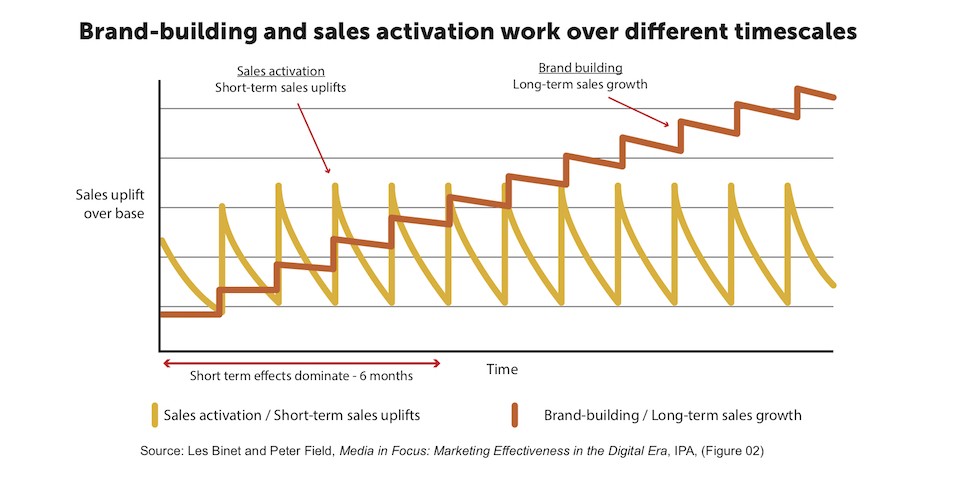
If you want to build and grow your brand, your content should balance a 60-40 balance between long-term brand and short-term campaign. This is based on research and data over 25 years. Please check Les Binet's brilliant work for more details.
“… if you want long-term growth, what you've got to do is change people's minds in some way. You've got to build up memory structures that will bias their behaviour into the future, and that's a much more difficult and long-term job, because it involves training people's responses in such a way that you not only influence behaviour now, but you also influence behaviour tomorrow, next week, next month, next year, and on into the future.”
WARC: “We’ve recently seen Adidas and eBay acknowledging that they had become addicted to performance marketing and were looking to make a change. How do you think some of these enormous brands have become over-reliant on performance marketing?”
Binet: “The addiction to the short-term is not a new phenomenon, but it has got a lot worse. One of the problems is that (for) short-term activities, you get immediate feedback: responses, clicks, or short-term sales. If you are a marketer who's spending money and nervous about what you're getting for your money, you can immediately see that this stuff pays back. It's become easier and easier to see these short-term effects, because we have more granular short-term data that comes through faster and faster."
Source: Les Binet on why long-term marketing matters in the age of short-termism (WARC)
2. Essential for SEO
Your long-term brand building content is, by excellence, your thought leadership content. Where you can make your claim, tell your brand's story, and show that you care by explaining how your brand and products are solving your customer's problem.
This is where the SEO game starts. The better, more up-to-date your brand-building content, the higher your ranking.
SEO as a KPI
It's no secret that SEO is a great indicator of your content quality. The higher your quality, the higher your ranking, as your content answers your customer's search query.
That's also why you should include your SEO ranking as a content KPI for the C-suite. Don't use this KPI to optimize for keywords; use it as an indicator of the quality of your content.
3. Your content feeds AI
For this, I have no hard data, just common sense. We know that AI is trained on huge data sets, and it uses public information on the web to create output.
ChatGPT and other AI tools tap into your .com, searching for input and answers. So, the better your content, the more likely you'll pop up as one of the visible sources in AI. Especially if you put your audience first and answer their question in your content immediately.
AI and Google's AI search (SGE) use your content for the so-called ‘zero-click’ content in their output.
AI loves zero-click content
Zero-click content exactly as the name reveals: zero clicks are needed to reveal the message. This means that you give insights and provide complete, valuable information directly.
AI uses this to create its output, as this type of content is structured to give the full message or benefit directly. The most important is first, and the structure of the content is very clear and easy for AI to scan. You'll find more tips on how to do this in ‘Writing for busy readers’.
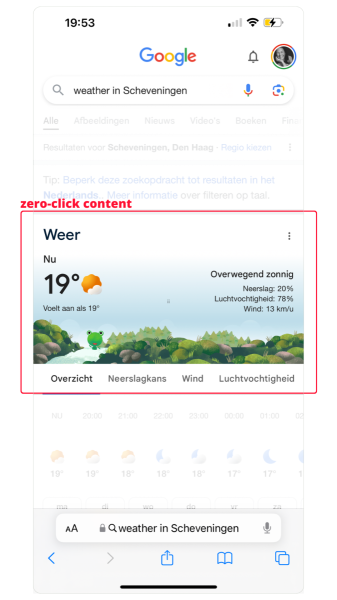
Below is an example of zero-click content in Google: You don't need to click any further to get the answer to your query ‘weather in Scheveningen.’ This same setup works in Google SGE for, e.g., ‘how to make a cappuccino’, and if you're a coffee company, you want your content to pop up, right?
For now, this will not be a huge yet. However, it never hurts to feed AI with the correct information, as we know this is going to be big.
Wrapping it up
Convincing your peers in the C-suite to get a budget is always a game of give and take. You can only spend the money once, and preferably, you have direct, measurable results. Unfortunately, this is not how content works. It's a long-term investment with continuous spending to build your brand, something you can't really capture in absolute numbers.
That said, your peers are not stupid and just need a little nudging to free the budget.
These are some pointers you could use
- 60-40 brand building rule
- Essential for SEO
- Your content feeds AI
And please, don't forget to have some fun along the way. :) Not only during the budget battle, also when producing the content.
Need help?
If you need any help with all of the above—and I’m not biased at all—I’m thoroughly experienced, have ruffled many feathers, and have learned from my mistakes, drop me an email. If I’m not the right person to help you, maybe I can recommend someone or an agency from my network.
Stay ahead: subscribe to my newsletter
If you want to stay up to date on AI, content, and marketing based on insight and how it matters to you, subscribe to my LinkedIn newsletter.
Two-click subscribe, and one-click to unsubscribe if you don’t like it.
Easy does it.
 Powered By PressPage