


AI explained for human beings: from prompt engineering to agents to agentic
You ordered a prompt course. Your employees want to build agents
Most people treat AI like a search engine. They type a question, read the answer, and move on. But it is the lowest possible use of the technology sitting in front of them.
To use AI well, three things matter.
- How you prompt. The quality of your question determines the quality of the answer. It is learning to communicate with AI.
- What you build. Configuring your AI to personalize it. For the prompts, once you know what works, you can turn it into an agent. An agent is a preset prompt, instructions you build once and reuse. You or your team provide the input. The agent does the thinking.
- How far you automate. When an agent no longer needs a human to start it, it becomes agentic AI. It acts on its own. It monitors, processes, and reports, without anyone clicking start.
These are the differences between saving hours a week and redesigning how your organisation works.
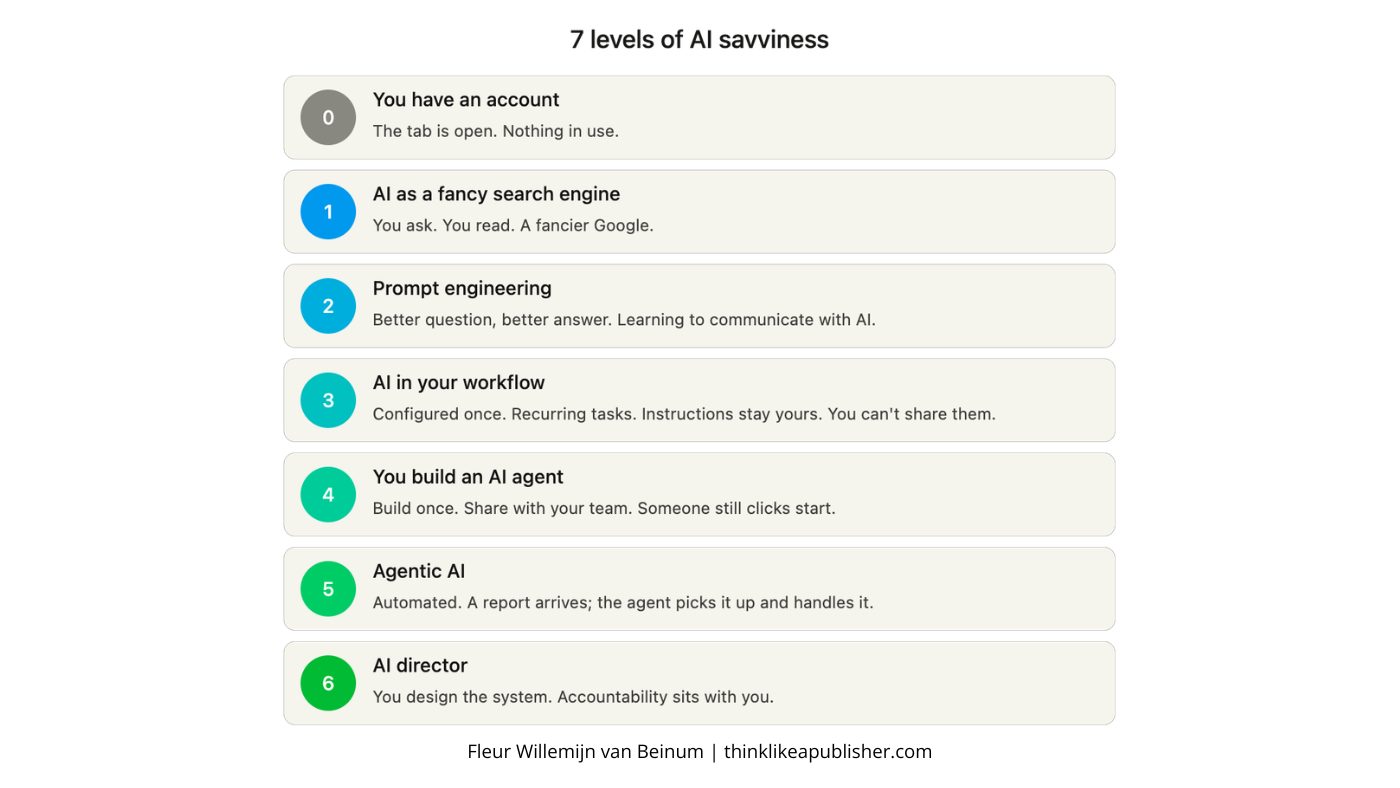
What are the 7 levels of AI savviness?
Here is what those levels look like in practice.
Level 0. You have an account You signed up for ChatGPT, Claude, or Copilot. Maybe tried it once. But in practice, you don't do anything with it. The tab is open somewhere.
Level 1. AI as a fancy search engine You ask a question and read the answer. That's it. You don't explain who you are or what you're trying to achieve. A fancier Google.
Level 2. Prompt engineering You discover that a better question gets a better answer. You add context: who you are, what you need, and who it's for. This is called prompt engineering, but it's really just learning to communicate with AI.
Level 3. AI in your workflow You configure your AI once: who you are, how you work, what you need. You structurally use it for recurring tasks like summarising a report or preparing for a board meeting. The prompts are yours. Unlike an agent, you can't easily share them with colleagues.
Level 4. You build an AI agent An agent is a preset prompt, the instructions you build once and reuse. You use it yourself, and you can share it with your colleagues too. They don't need to know how it works, they just give the agent their input. Someone still clicks ‘start’.
Level 5. Agentic AI No human needed to set things in motion, it’s automated. A new report arrives? The agent picks it up, processes it, and sends a summary to the board. Automatically, without anyone looking over its shoulder.
Level 6. AI director You no longer manage individual agents. You design the system they operate in: the rules, the boundaries, and the QA and accountability structure. When something goes wrong, it sits with you. Not the technology. Not the agent.
Where most organisations get it wrong
Most companies still think they need to train on level 2. Prompt engineering. How to ask better questions. Their employees have already moved on.
According to the SmarterX report, 58% of employees want to build workflows. 51% want to work with agents. 45% want no-code tools. Only 15% cite prompt engineering as a training need.
The workforce has self-educated past where most training programmes begin.
Board-level leadership runs to two extremes, and both leave the organisation exposed
Two things are happening, and both are a problem.
- Digital shame: knowing AI ownership belongs at the top, and not moving anyway. Most board members are stuck at level 1 or 2.
They know they need to step up. But the topic feels overwhelming and there is never enough time to act on it. So they don't.
- Most advanced AI users. CEOs and senior leaders are, according to the SmarterX report, personally the most advanced AI adopters in their organisation. Think level 4 or 5.
They build, they automate, they move fast. They think their employees are where they are. A blindspot, because the majority of their organisation is at level 2, and hungry to reach level 3.
You have two options
Start privately. Get yourself to level 4 before you ask your organisation to.
Or lead publicly. Move first. Show your organisation what AI-literate leadership looks like in practice.
Both work. Doing nothing does not.
Join 2,500+ professionals
Most content advice tells you what to do. This tells you how to think. For marketers and communicators who want the difference.
Free. Unsubscribe anytime.
 Powered By PressPage