

The AI results you read about don’t come from the tool
Results come from a workflow built around AI, and very few teams have one
91% of marketers use AI. 70% of CMOs say their processes aren’t ready to scale it. The tools are in. The licences are bought. The training is done. The workflow isn’t.
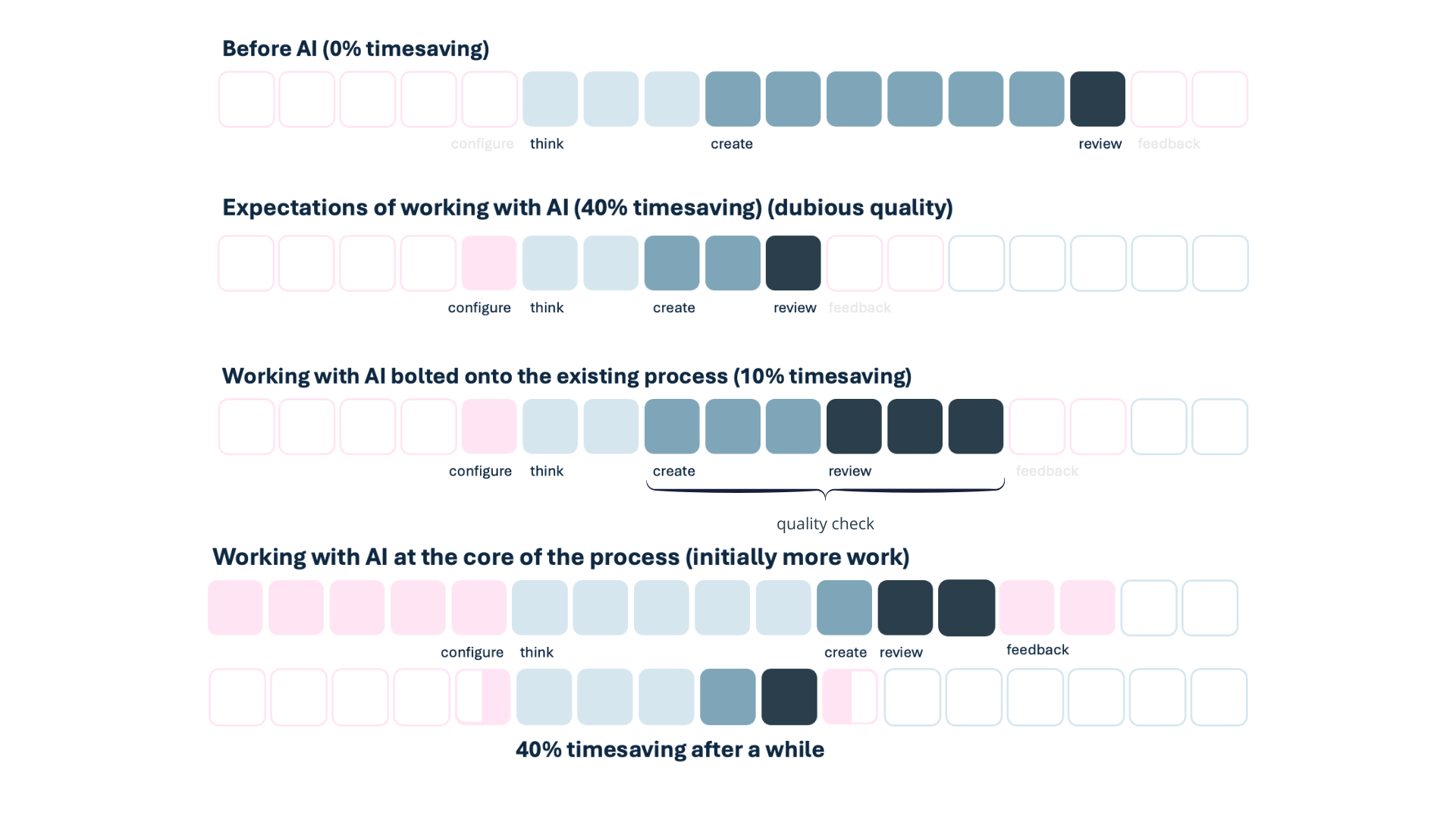
AI rarely delivers the savings you read about when it’s bolted onto the workflow you already have. The main issue is quality and sounding generic. Drafts come fast, but the thinking that used to happen while writing now happens nowhere. The time you save on writing, you lose in review.
The fix is to put AI at the core of your workprocess as a strategic partner and assistant: configure it, do the thinking upfront, let it reason and check with you. This setup costs more work and needs different skills at first, but it improves quality and saves time the more you use it.
This flips when you produce not that much little content with low stakes: then bolting AI onto you exisiting workprocesses is enough.
Nobody deliberately chooses a ‘bolted-on AI’ workprocess
Many teams bolt AI on their exisiting workprocess instead of building a new workflow around it. Nobody chooses that deliberately. And few are aware that their workflow can, and should, be rebuilt around AI. Why rebuild a workflow that already got a little faster?
Keeping up with AI is a job in itself. Most directors and teams already have one.
→ But skip the thinking and configuration upfront, and you pay for it in review.
Before AI the thinking used to happen while writing
Before AI, a writer found the angle while writing. The argument got sharper with every paragraph. Even with a strong brief, the sharpening happened while writing.
AI skipped that step. It turns a brief into a draft in ninety seconds, so nothing gets sharpened on the way.
The thinking has to move upfront: into the configuration and the brief, before AI writes a word.
My own workflow build around AI, step by step, is in How the work moves when AI sits at the core.
‘AI bolted on’ delivers faster drafts and slower reviews
I see it in many teams I work with: the drafts come fast, and the hours move to review. The first draft looks finished. Read it properly, and it’s shiny on the outside, empty on the inside. So the coreting loops start. “Make it more personal.” “Less corporate.” The brand guide gets pasted in.
The thinking that never happened in the brief now happens in the review, at the wrong end of the line.
‘AI at the core’ moves the workload to the front
I built a campaign agent for a marketing team, with the same setup I use for my own writing, and shared it with the whole team.
Before, a campaign piece took 12 to 16 hours from brief to approval, spread over about 2 weeks. Now it takes 4 to 6 hours, done in 2 days.
Configuring the agent took me about 4 hours: 2 upfront, the rest in small updates as we learned what worked. I can do that fast because I’ve done it many times. How long it takes the first time, I honestly can’t say.
One check made the biggest difference. Before anything goes for approval, the agent answers one question: “If [stakeholder] reads this, what feedback will they give me?” The review rounds happen before the review.
Two quick review rounds, and he signed it off.
His brief to me was simple and short, in human language as if we were having a chat at the coffee machine. My brief to the AI agent wasn’t: the setup, the process and all the checks were built in. Briefing AI isn’t my stakeholder’s job. It’s mine. His job is a clear message.
Start here
Ask your team for the last important piece made with AI. Where did most of the hours go: before the first draft, or after it? If after, you’re bolted on.
The AI results you read about are real. They come from teams that built their workflow around AI. Not from a better tool. Right now, your old workflow decides how much AI saves you.
If you want AI at the core of your team’s work, I’ll build the setup with you, and hand it over.
9 AI dilemmas
This is the third of 9 AI dilemmas for the C-suite. I'm publishing them over the coming weeks. Each piece names the decision, what it costs to leave it open, and what I'd do.
The one you recognise immediately might be the one you've left open too long.
- Faster with AI means more errors
- Secure AI means weaker AI
- Your board wants AI to make marketing cheaper. Your brand can't afford it
The AI results you read about don’t come from the tool (this page)
Sources
- Jasper, The State of AI in Marketing 2026. Note: Jasper sells AI marketing software.
- Gartner, 2026 CMO Spend Survey
Join 2,750+ professionals
AI changes how the work gets done. I test it in my own work and write about what actually works.
Free. Unsubscribe anytime.
 Powered By PressPage