

An AI license costs less than 1% of a salary. Too many boards still say ‘no’
The license should be the easy decision; what you do with the freed-up time isn't
As CMO, I spent 6 months fighting for a paid AI license for my team. 6 months, for € 312 a year per person. It blows my mind that some boards still doubt getting a paid Copilot license.
By July 2026, Microsoft counted more than 30 million paid Copilot seats. The number of new seats sold more than doubled in a single quarter, and the number of companies rolling Copilot out to most of their staff grew by nearly 75%. Your competitors aren’t waiting.
Get the license. It costs less than 1% of a mid-level marketer's salary and pays for itself at 25 minutes a week. In my team, it saves each of us at least 4 hours a week: 10% of a 40-hour week.
The real decision is what you do with that time. Use it to cut people, and you get more of the same. Invest it in quality, and you get more of something better. Start with a few teams and report to the board as you go.
It flips if you skip the training, the workflow adjustments and the governance setup. Then AI becomes just another tool, and counting hours is the more honest case.
Saying ‘no’ doesn't keep AI out
Hold back on the license, and your people bring their own AI, with the data risks that brings. Meanwhile you fall behind in learning to work with AI, exponentially.
And the people who are the best with AI are the first to look elsewhere.
The board's doubt is reasonable
The cost is certain: a license for every employee, every year, plus training and governance in the first year. The return isn't. Even among organizations already using Copilot, 51% of IT leaders name proving its value as one of their top three barriers.
If you have 300 employees, you’re facing around € 94,000 a year in licenses alone. That’s serious money.
The math is the easy part
The license costs around € 26 a month: € 312 a year, excluding VAT. That's just under 1% of a mid-level marketer's gross annual salary. And that's on the safe side of the calculation. Against what that marketer costs you in total, somewhere between € 60,000 and € 85,000 a year, it's closer to 0.5%.
Microsoft’s own research puts the average user at 14 minutes a day. That’s 70 minutes a week, almost 3 times the 25 minutes the license needs to pay for itself. Everyone in my team saves at least 4 hours a week. That’s 10% of the time, against 1% of the salary.
Even if only half of the time saved comes back as output, the license still pays for itself 5 times over. The other half is where the real gains come from: quality.
→ You don't need to cut anyone to make the sum work.
We use Copilot for writing and summaries like any AI tool. The real difference is what the paid license adds: it has access to our own work. Copilot searches our inbox, Teams chats and SharePoint. We transcribe important meetings and chat with the transcript. And like in ChatGPT or Claude, we built strategic and operational AI agents where we shape projects and decisions. Ours draw on our own files and meetings.
The free version of Copilot can’t reach your documents, chats and meetings. The paid license can.
Cutting people buys you more of the same
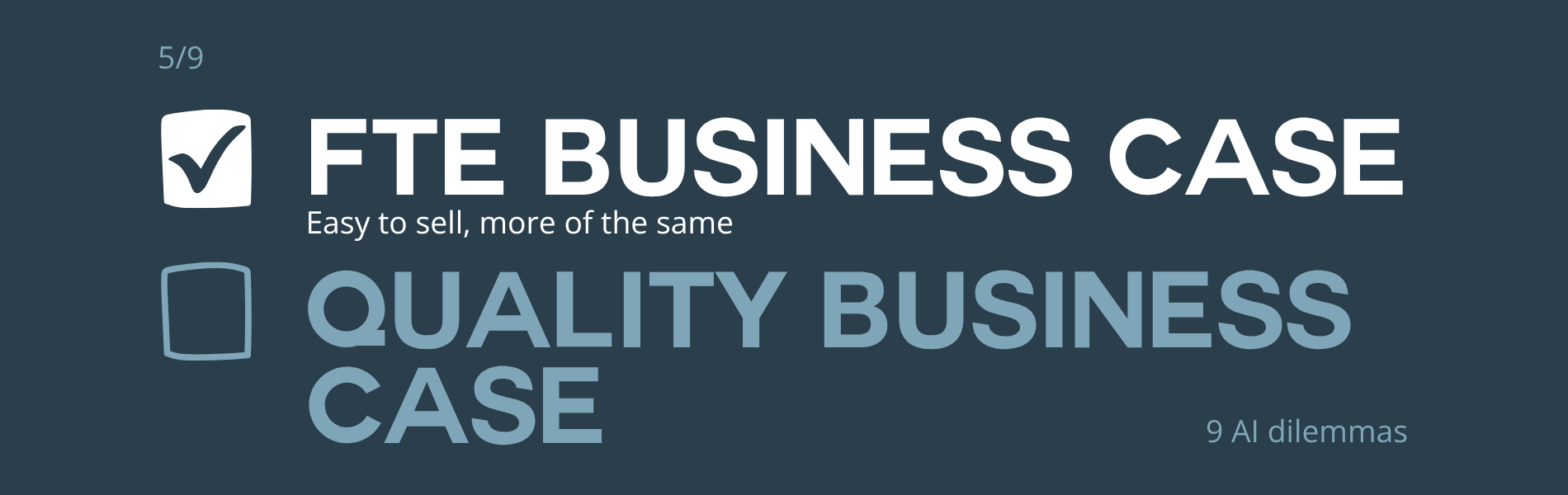
The business case that sells easiest counts the saved hours as FTE. Half an hour a day, times 300 employees, is almost 19 full-time jobs. Finance likes it, because it shows up in the budget.
Forrester warns marketing agencies against exactly that: mistaking efficiency for effectiveness. An emphasis on efficiency helps in the short term, it says, but stifles creativity and growth over the long term.
Cut people, and you cut the learning capacity and the craft that keep the gains growing. The people who stay get the same to-do list, with fewer hands and a faster tool.
→ Fewer people is an FTE decision. It gets you more of the same.
Invest in better work, and the volume follows
Better work puts investment first. Quality follows, then volume. Initially it takes more time and money.
The investment is in training, in learning to work with it, in adjusting the workflow, and in governance, so Copilot only sees what it should.
In my team, the saved time splits about half and half:
- Half goes into getting more done. The to-do list gets shorter and more manageable.
- The other half goes into the work itself: in-depth strategic sessions, reviewing our own work and processes, feedback.
And it compounds. Time spent on the craft makes us faster, with better results. People enjoy the work more, and they get more done. Oxford researchers found people are 13% more productive when they're happy, in the same hours.
It took about 6 months of learning before the gains showed. With the 6 months to get the license, it’s a year before the value shows. And it’s a year you can't buy back later.
Start with a few teams. Report to the board as you go: the time you gain, where you struggle, what other teams can copy.
Marketing is a natural first team: a heavy user, seen as a cost center and often understaffed. That's how we did it.
Start here
Ask your team one question: how many hours a week do you spend looking for information you know is somewhere in your mail, Teams or SharePoint? Then ask a second: if you got that time back, what would you spend it on?
The first answer is your number for the board. The second tells you whether your team wants more work, or more breathing room to do better work.
The short-term FTE saving is the most expensive long-term option
Saying ‘no’ to the license is a mistake. Using it to cut people is a bigger one: a missed opportunity disguised as a saving.
Neither is smart if you take your brand, your business and your competitors seriously.
If your board still says no, I'll help you make the case, and decide what the time is for.
A note on Google Workspace
Gemini is already bundled into most Workspace plans, so there the license is hardly a cost question. But you work with the platform you have, and for many organizations that’s Microsoft.
Gemini can connect to Microsoft files through Gemini Enterprise, but that’s another paid license, and it works next to your Microsoft apps, not inside them.
9 AI dilemmas
This is the fifth of 9 AI dilemmas for the C-suite. I'm publishing them over the coming weeks. Each piece names the decision, what it costs to leave it open, and what I'd do.
The one you recognize immediately might be the one you've left open too long.
- Faster with AI means more errors
- Secure AI means weaker AI
- Your board wants AI to make marketing cheaper. Your brand can't afford it
- The AI results you read about don’t come from the tool
- An AI license costs less than 1% of a salary. Too many boards still say ‘no’ (this page)
Sources
- Microsoft FY26 Q4 earnings call, 29 July 2026 (vendor)
- Microsoft 365 Copilot pricing, Netherlands, excl. VAT ($30 a month US list price)
- Mid-level marketing salaries, Netherlands 2026, aggregated from Hays, Robert Half and Yacht
- Microsoft WorkLab, the 11-by-11 tipping point (vendor, self-reported)
- Gartner, Microsoft 365 Copilot and Agents: Assessing Impact and Value in 2026 (June 2026)
- Computerworld, Copilot pricing gets complicated
- Microsoft Support, how Copilot Chat works with and without a license
- Google Workspace and Gemini pricing
- University of Oxford, Happy workers are 13% more productive (2019)
- PwC, Global Workforce Hopes and Fears Survey 2026
- Forrester, The State Of AI Inside US Marketing Agencies, 2026
Join 2,750+ professionals
AI changes how the work gets done. I test it in my own work and write about what actually works.
Free. Unsubscribe anytime.
 Powered By PressPage