

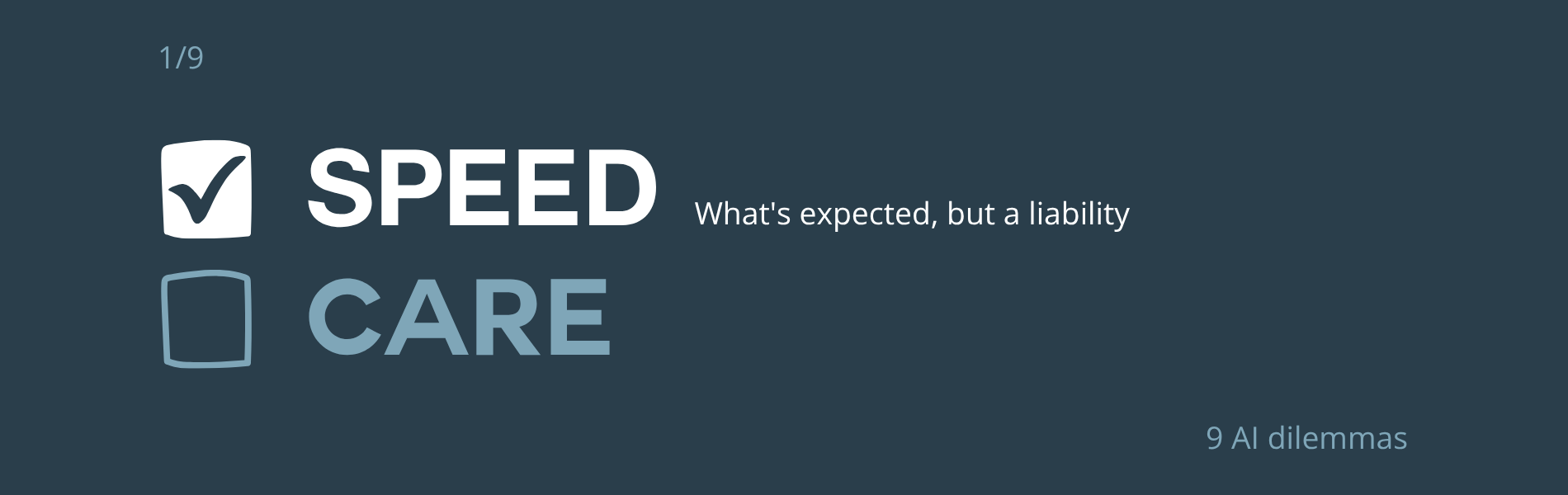
Faster with AI means more errors
Unless you build the checks in before you speed up
Every brand working with AI runs into this. You want the speed, but not the errors that come with it. You can have both, and stay safe and on brand. It’s actually quite simple, if you know how.
36.5% of marketers say incorrect AI content has already gone public. And 83.5% are expected to produce more because of AI.
My advice: build it into the process
Build quality into how your team works with AI. Put serious time into the setup before AI starts writing, so it works from your facts, your sources and your voice. Then add multiple checks along the way, not only at the end.
This slows you down at first. After that, you're faster and safer with every piece.
→ Quality control shouldn't be an editing step. It should be part of the AI workflow itself.
Yes, the setup slows you down, for a few weeks
You bought AI to go faster, and now someone tells you to slow down first. That's a hard sell when your AI investment has to pay back this year.
But the pace changes once your setup is in place. You build the setup once and use it for every piece after. The more you publish, the less manual work each piece costs.
If you only produce a handful of pieces, it flips. Then the setup costs more than it saves, and one very careful check at the end is enough.
More than 70% of marketers already spend one to five hours a week fact-checking AI output. A team that checks everything by hand at the end pays the full price every time.
→ The setup is a cost once. Skipping it is a risk every time.
AI errors are predictable
AI doesn't fail at random. The same kinds of problems show up again and again. AI tends to fail in five predictable ways:
- makes things up
- leaves things out
- uses outdated information
- answers a different question than the one you asked
- uses language your brand would never use
That's good news. What you can predict, you can check for. That means replacing a vague "have a look before it goes out" with a specific check for each failure mode.
→ Predictable errors are preventable errors.
Checking only at the end is too late
Many teams check AI content at the end, if they check it at all. By then, an error is baked into a finished piece. Catch it, and you have rework nobody planned for. Miss it, and it goes out under your name.
Put the time in earlier. Configure AI before it writes and build checks into the process, then check again just before publication.
Skip those checks and you get cases like DPD, whose chatbot swore at a customer, or lawyers filing case law that AI made up. In both cases, AI-generated output reached the outside world when it shouldn't have.
With my clients, we haven't had an AI error make it through to publication. Not because AI doesn't make mistakes. Because we double down on configuration and checking throughout the process.
Start here
Ask your team to walk you through one piece made with AI: from the setup, to the brief, to the checks, to publication.
Then ask one question: does anyone ask AI to check and challenge what it wrote, or do we only check the links?
If it's only the links, quality isn't built in. It's hoped for.
Fast and safe is a decision
Speed and safety can go together in a process that’s built for both. Set it up once, use it often, and check your setup regularly, especially when the AI or model changes.
Without that process, deadlines and workload decide how much checking gets done.
If you want to move fast without compromising on quality, I can help you build the process. Email me directly.
9 AI dilemmas
This is one of 9 AI dilemmas for the C-suite. I'm publishing them over the coming weeks. Each piece names the decision, what it costs to leave it open, and what I'd do.
The one you recognise immediately might be the one you've left open too long.
- Faster with AI means more errors (this page)
- Secure AI means weaker AI
- Your board wants AI to make marketing cheaper. Your brand can’t afford it
Sources
- NP Digital, AI Hallucinations and Accuracy Report (February 2026)
- HubSpot, State of Marketing 2026
- DPD chatbot incident (January 2024)
- AI hallucinations in court filings
Join 2,750+ professionals
AI changes how the work gets done. I test it in my own work and write about what actually works.
Free. Unsubscribe anytime.
 Powered By PressPage