

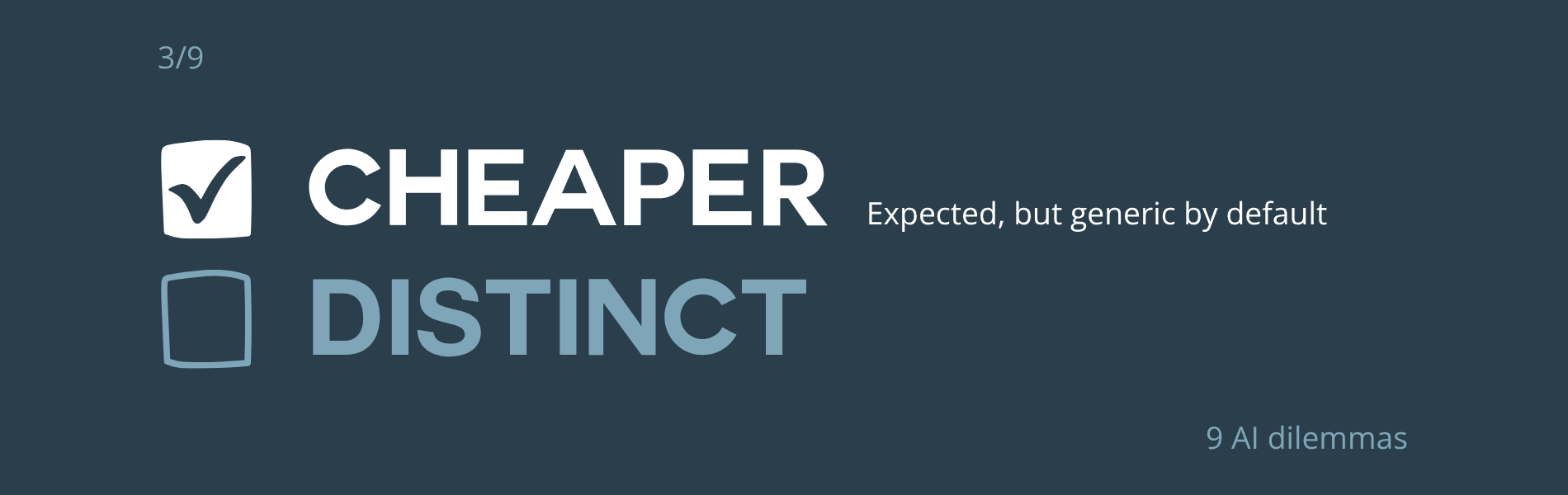
Your board wants AI to make marketing cheaper. Your brand can’t afford it
Unless you invest the time AI saves in what makes you distinct
Your CEO and CFO think AI makes marketing more efficient, so they expect it to cost less. As CMO, you want that too. But you fear the moment AI at scale makes your brand sound like everyone else's.
You can do both, by design: save with AI and stay distinct:
- Obsess over configuring AI on your point of view, for everything you make. Then decide at management level how much human work each piece gets, so the team's workload doesn't decide for you.
- Where little is at stake, let AI produce it fast. Where your name, reputation and conversion are on the line, more human time goes in, and that's where the savings go.
This flips at both ends:
- When customers buy on price and availability, AI can produce most of it fast.
- When your thinking is what you sell, nearly every piece needs that human time.
Right now, the savings target decides
Marketing budgets aren’t growing. In Gartner’s 2026 CMO Spend Survey, marketing spend went from 7.7% of company revenue to 7.8%, while CMOs were still expected to grow the business, work more efficiently and make AI work. 56% say they lack the budget to deliver their 2026 strategy.
So the savings target is already in the budget, while the workload and deadlines stay the same. Every piece gets the fast AI treatment, including the ones that carry your reputation. Nobody chose which pieces get more human attention.
Hit the savings target with a basic AI setup, and you sound like everyone else. Hold AI back, and you lose the budget fight.
Taking the savings is a reasonable call
The rest of the board expects marketing to save budget by working with AI. The return on a distinct brand is hard to prove. And competitors are cutting too, so why pay more to stand out?
Most content is skimmed, not read. Customers rarely notice the difference between good and very good. Let alone your brand voice.
Fair, for content nobody chooses you for. But where people decide whether to trust you or buy from you, good enough is how you disappear.
AI doesn’t have to sound generic
Many leaders think it does. So they see two options: cheap and generic, or human and expensive.
Few know there’s a third:
→ AI configured on a clear point of view. It takes time and skills most teams don’t have, and a point of view written down in plain language. That last part is usually missing.
AI can copy your tone, not your point of view
Many teams give AI the brand book and a few adjectives: bold, human, authentic. Every brand says that, so anything written with AI feels generic.
What you need is to feed AI with your point of view.
A point of view is what your company believes about its field and its customers' problems, especially where it disagrees with how things are usually done. It's a stance on something contested: what you think, and what you'd argue for in public. If nobody could disagree with it, it isn't one.
Your point of view also works as a filter, twice.
- Before you produce anything, it tells you what to say yes or no to.
- Afterwards, it's your quality check: does this fit what we stand for?
Without a point of view, every decision gets made from scratch, by the loudest voice in the room or by the deadline.
When I configure AI for a client, it takes me up to two weeks. More than 10 documents, written so AI agents can reuse them, and a lot of testing before I sign off. First for the brand, then for the people who speak for it. Very little of it comes from as a 1:1 copypaste from the brand book.
When I write for a CEO on a strong configuration, 95% is approved with a few small tweaks. Without it, it's review round after review round.
Not every piece deserves the same hours
Some content decides whether people see you as the expert, trust you or buy from you: the homepage, the campaign, the pitch, what your CEO publishes.
Other content just has to be correct and on brand: product specs, service answers, frequently asked questions. AI works on both. The difference is how much human time each one gets.
In many teams, that difference doesn't exist. The same people give the CEO's opinion piece the same time as a product description. Or both come out of AI with the same quick edit.
→ Where to invest more human time is a management call, made once. Not a deadline call, made by the team every day.
Spend the AI time savings, don't bank them
The time AI saves on volume content pays for more human time on the content that matters most. Spend it there. Not on cutting the team, and not on publishing more.
AI saves around 40% of your time at first. Done right, about 10% ends up as savings. The rest goes back into configuration and the thinking that makes you distinct. Your board still gets savings, just smaller than the spreadsheet promised.
Gartner's survey points the same way. Even though AI is assumed to cut people costs, labour's share of the marketing budget rose from 21.9% in 2025 to 24.5% in 2026, a sign that AI's value depends on people, skills and execution. And what holds CMOs back most is a lack of AI expertise and talent in-house, cited by 38%.
→ The ROI isn't in the hours saved. It's in what you do with them.
Start here
Write down your company's point of view on what matters most to your customers. Five sentences, in plain language, without the brand book.
Then show it to a colleague on the board. If they'd write something different, or it's new to them, you've found what your AI is missing.
Cheaper where you can, distinct where it matters
Right now, the savings target makes that call. It should be yours.
If your board expects savings and your brand can't afford to sound generic, I'll help you write the point of view and set up AI to work from it. Email me directly.
9 AI dilemmas
This is the third of nine AI dilemmas for the C-suite. I'm publishing them over the coming weeks. Each piece names the decision, what it costs to leave it open, and what I'd do.
The one you recognise immediately might be the one you've left open too long.
- Faster with AI means more errors
- Secure AI means weaker AI
- Your board wants AI to make marketing cheaper. Your brand can't afford it (this page)
Sources
- https://www.gartner.com/en/newsroom/press-releases/2026-05-11-gartner-2026-cmo-spend-survey-finds-cmos-allocate-15-point-3-percent-of-marketing-budgets-to-ai-but-only-30-percent-are-ready-to-scale-ai-capabilities
- https://www.gartner.com/en/newsroom/press-releases/2026-06-08-gartner-marketing-survey-finds-awareness-and-conversion-account-for-62-6-of-total-media-spend
- https://www.thinklikeapublisher.com/use-ai-to-create-better-content-not-just-more/
Join 2,750+ professionals
AI changes how the work gets done. I test it in my own work and write about what actually works.
Free. Unsubscribe anytime.
 Powered By PressPage