

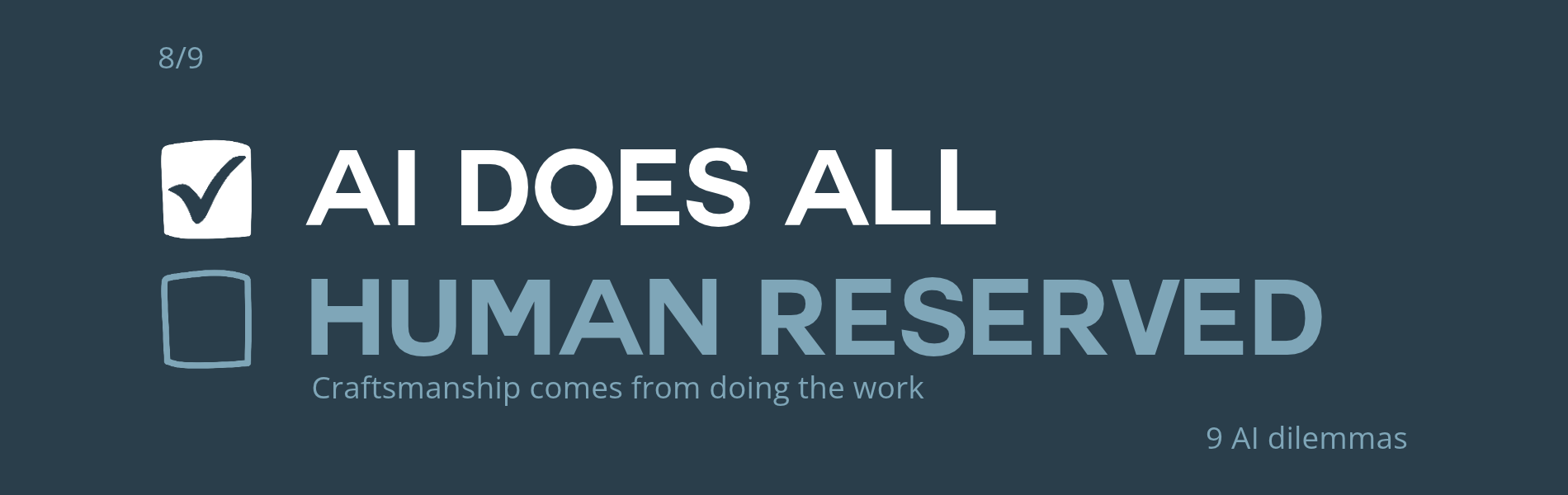
Some tasks should be human reserved, even when AI does them well
Or your team can't tell good from good-looking, and your brand turns generic
46% of marketing leaders believe heavy AI use could weaken the creative skills of junior marketers. 51% worry AI is pushing brands into a sea of sameness (Optimizely, 2026).
AI amplifies what you bring. With craft and creativity, it makes great work faster. Without them, it makes shiny work that's empty inside.
My take: use AI responsibly. Leave some tasks to humans, even when AI does them well, so your team learns the craft and keeps its creativity sharp. And invest half the time AI saves in learning.
The exception is commodity content, where fast and good enough will do: product descriptions for hundreds of items, meta descriptions, an internal meeting summary.
Don't decide, and your brand goes generic while your team loses its craft. It happens slowly, and you hardly notice. A few years later, your team is hollowed out. And very few people are left who can fix it.
Why pay people for what AI does well?
A reasonable CMO says no to humans doing by hand what AI does well and fast. The board expects savings. Competitors do the same. And maybe juniors are better off learning AI than learning the old way.
Fair point. But craft isn't the old way. It's what makes AI worth using in the first place.
Give AI craft, a clear point of view and real insight, and it makes your work better, faster and on brand. Give AI a brief with nothing underneath, and it still delivers: something shiny on the outside, but empty and generic on the inside.
Craft and creativity only grow by doing the work
Junior roles used to be where people learned the craft: write a draft, get feedback, write a better one. Now AI does most of that work, and it does it well and fast.
→ With AI, the practice disappears, while juniors are expected to bring more skills to the job.
I see it with junior content and social marketers in my team. They never learned the basics of marketing, copywriting or design. That's not their fault: you don't know what you don't know. They float on the surface with AI and tools, and don't know how to go deep or do extended research. Their work looks finished, but it could belong to any brand.
So I nudge and challenge them to do some of the work themselves: research how other brands do it, and recreate it by hand. All to learn the craft and the skills that go with it. A DIY mentality, instead of asking AI.
Give half of the time that AI saves to craft
It's tempting to use the time AI saves you to make more. In An AI license costs less than 1% of a salary, I made the business case for that time.
→ My tip: give half of it to craft. That's my 50-50 split for 2027, and it may shift over time.
Sometimes the best brief for a junior is: do this one without AI. Not Copilot, not the AI assistant in the tool. Figure out yourself what makes an idea stick, why a headline lands, why a layout makes the copy easier to read.
→ Some work needs to stay human for everyone, like the review and the final approval.
Other work stays human until your juniors have their fundamentals in place. Once they do, AI makes them better. Without marketing craft, they can't build anything that sets you apart.
Start here
Ask one of your junior marketers why their last piece works. Why that angle, headline or image. If they can't explain it from the craft or from cases they know, they need more time on the craft, not on AI.
Now that everyone has AI, craft and creativity are what set you apart. Keeping them strong doesn't happen on its own. You have to decide which work stays human.
If you want AI speed without losing the craft, I'll help you set it up.
9 AI dilemmas
This is the eighth of 9 AI dilemmas for the C-suite. I'm publishing them over the coming weeks. Each piece names the decision, what it costs to leave it open, and what I'd do.
The one you recognize immediately might be the one you've left open too long.
- Faster with AI means more errors
- Secure AI means weaker AI
- Your board wants AI to make marketing cheaper. Your brand can't afford it
- Want the AI results you read about? Look at your workflow, not your tool
- An AI license costs less than 1% of a salary. Too many boards still say ‘no’
- You can delegate AI. You can’t delegate understanding it
- Legal wants to AI-label everything, marketing nothing
- Some tasks should be human reserved, even when AI does them well (this page)
Sources
- Optimizely, 2026 global study
- An AI license costs less than 1% of a salary
- AI amplifies the junior roles
Join 2,750+ professionals
AI changes how the work gets done. I test it in my own work and write about what actually works.
Free. Unsubscribe anytime.
 Powered By PressPage