


Writing for busy readers; simplify your writing to make reading easy
People don't read, they hunt for information
How do you get a busy audience to read your content? Simple: make reading easy. But writing what’s easy to read is not easy to write.
→ Marketers are overcomplicating everything because they think sounding smart is the same as being smart
The simpler and shorter you write, the more expertise and knowledge you show. The benefits of simplifying your writing:
- Easier to read
- More engagement
- Increase purchase intent
I shamelessly copied, pasted, adjusted, and mixed parts from multiple books and podcasts, completed with my 25 years of marketing and content experience.
My advice applies to all content, from social to in-depth, detailed, long reads. There are just 3 exceptions to this rule in chapter 2, and those probably don't apply to your content.
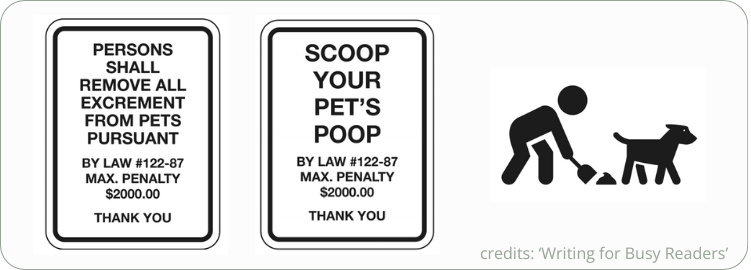
Credits where credits are due. Please read ‘Writing for Busy Readers’ by Todd Rogers and Jessica Lasky-Fink and listen to the 20-minute Nudge podcast ‘How 22.000 were persuaded to clean sewage’. In the last paragraph, all sources and further reading.
What you'll learn
This is how you should spend your time when creating content: 70% for thinking and research, 20% for writing, and 10% for formatting. Here's why and how to do this.
- Put yourself in your readers’ shoes
- Simplify your writing to make reading easy
- Optimize formatting for faster reading
- Bottomline first
- The '… but my reader is highly educated’
One more thing, there's no golden rule about the ideal length of your content. Always, as short as possible and as long as needed. When your content loses value, it's too long,
1. Put yourself in your readers’ shoes
Understanding your audience is key. This is where most marketers make the mistake of writing about what they want to say, not about what matters to their audience. You'll lose the ‘what’s in it for me?’ perspective. Todd Rogers explains this by ‘so what’ and ‘why me’.
- The ‘so what’ indicates that people only spend their time and energy on things that directly affect them, the reader. It has to have a value or a benefit, solve a problem, or give them knowledge or an advantage.
- The ‘why me’ indicates that you must clearly state to whom this content applies and who does not. Nothing is as annoying as reading content that’s irrelevant. You can do this in your title or the first paragraph. I always state the reader’s problem I’m solving in the first sentences of my content.
How to do this
- My first tip is to use the ‘what’s in it for me’ principle; combine the problem–solution–benefit with ‘to know,’ ‘why it matters, and ‘to do.’ By writing down these 6 elements, old-school with pen and paper, I sharpen my thinking and put myself in my reader’s shoes.
- Another tip is that I always start my writing with ‘Dear Judith’. Judith is one of my former clients, a big hotshot CMO, and an amazing lady. In the beginning days of content, she always picked my brain on content and how-to’s.
So, every time I’m about to explain something complex in a simple, fast, and easy way, I imagine I explain it to her. This keeps my tonality light and human and makes me answer her question instead of me lecturing about what I know.
2. Simplify your writing to make reading easy
Complex and long writing gets ignored. Simple writing makes it easy to read, and it's less likely they’ll quit and move on.
→ Making the complex easy to understand shows you care and are an authority.
The other benefits of simplifying your writing are higher engagement and increased purchase intent. Research in ‘Writing for busy readers’ explains and proves both.
Tools and AI
- Use Hemingway to grade and lower your reading level. The more you use this free app, the easier it gets and the simpler you’ll write.
- Use AI. Add ‘write at B1 intermediate English, reading level 8, and avoid jargon without dumbing it down’ to your prompt; you’re already halfway there.
Stick to 1 topic
This is another common pitfall. We love to be complete and comprehensive, showcasing everything we know, listing every detail and related item that matters. This results in lengthy, wordy, complex content that gets ignored — the opposite of your objective.
Stick to one topic per content item. No exceptions.
- If you have many details, condense them and use fewer words. Sacrifice your ‘I know all the details’ for a higher engagement.
- And if you really want to showcase what you know, create a separate content piece with the title ‘Deep diving into the details’, so the busy reader knows what to expect.
- If you have related topics, mention them shortly, create a new piece of content, and link to that. For a busy reader, nothing is as annoying as one long, cluttered, and confusing piece of content that jumps back and forth between related topics.
Structure
I also tend to overcomplicate and be extensive. Killing my darlings hurts, but if that improves my content, I’m happy to do so.
The best tip is to use your structure to prevent wandering off. I use problem – solution – benefit to focus on my one topic, and I always check and recheck that what I’m writing is related to that. If it’s too far or just related, I delete it.
Next, I always list the headlines of my content in the first paragraph, so my reader immediately knows what to expect, the structure, and whether it’s interesting to them.
Simple words
It’s all about using simple and common words in shorter sentences. Even Hemingway understood that, his award-winning book ‘The Old Man by the Sea’ is written at a fourth-grade reading level.
Most thought leadership content is at reading level 12 or above, which is post-graduate. Aim for 8 or 9 for clear and easily accessible writing. For social, even a 4 or 5.
→ By the way, writing at a lower readinglevel doesn’t mean you’re writing childish or dumbing down. You can still have technical, in-depth knowledge content at a lower readinglevel, it just takes more effort and knowledge to write.
Short sentences
For the length of the sentences, Todd explains this brilliantly in his book. ‘When we see a period ‘.’ at the end of a sentence, that indicates that a certain unified concept is now complete.
Readers then take a brief pause, process, and make sure they understand the completed sentence before moving on.
Longer sentences require readers to hold more content in their minds before they process the full sentence.’
Exceptions
Yes, there are exceptions to this rule:
- Patent filing
- Go-fund requests
- Content where some sort of extended human empathy is needed
Most probably, that’s not your content.
Now we know how to ‘put yourself in your readers’ shoes’ and how to ‘write simple for easy reading’, my favorite part; formatting.
3. Optimize formatting for faster reading
Formatting makes your content look sexy and engaging for busy readers. It also makes key information immediately visible.
With formatting, you can create a hierarchy, give structure, and apply visual anchor points, resulting in content that is easy to scan.
→ This ‘copy design’ is the most overlooked part of content creation.
We usually write and slam it online, not even thinking about how the content looks, let alone how it shows on a mobile screen. I love this part of content creation, as it allows you to become even more creative and stand out.
Increase reading speed
The average reading speed for simple writing is 240 words per minute, 4 words per second. The more complex the copy, the longer it takes.
But busy readers don’t have time, and they don't read; they skim and scan.
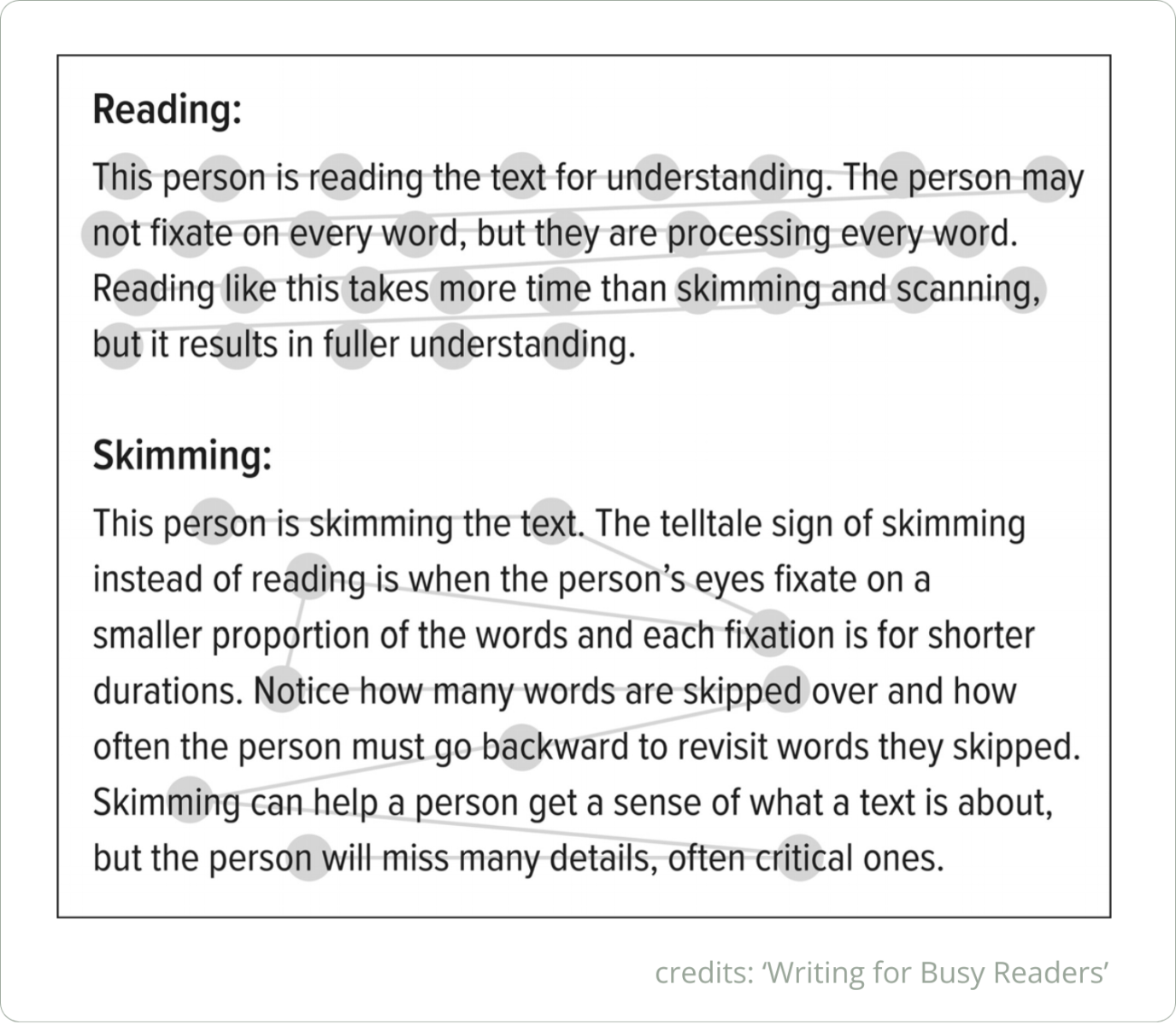
Use short paragraphs with headers
Use short paragraphs. Very short. And you group them together by using a header.
This applies even more if you’re writing for reading on a mobile screen, which is about 80% of your audience. Nobody gets excited by a wall of text on their screen. Let alone busy readers.
Generally, a mobile screen has about 9 words, 50 to 60 characters, in a line, which is 30% shorter than on a laptop screen. That results in +30% longer, higher, paragraphs.
Rule of thumb for mobile screens: very short paragraphs, two to three lines, with many white break lines and headers to group them together. These headers are the anchor points for your busy reader to scan your content.
Visual anchor points
Your reader uses these to quickly navigate, decide whether it's interesting, and scroll down or click away. These are your headers and subheaders, along with bold, underlined text and lists.
Use 3 styles: bold, underline, and lists
For digital content, my advice is to stick to 3 styles: bold, underline, and lists. By exception, italics only for prompts. I never use CAPS and never highlight to prevent my content from feeling cluttered and looking like a Christmas tree.
For underlining, it’s the unwritten rule that it’s only allowed for links. It is good to realize that an underlined link also serves as a visual anchor point. So, if you don’t want to emphasize the link too much, keep it short and use ‘⌘ +K’ or ‘control +K’ to hyperlink individual words.
What is most important to know is that using these styles gives your reader a license to skip the rest of your content. That circles back to ‘one topic’: Highlight your topic with formatting, and make sure you don’t hide relevant information in the regular body copy.
My tips and the squint test
- If my content on a laptop looks awkwardly white and ‘empty,’ I probably nailed it for a mobile screen.
- Toggle the mobile view on your laptop for a quick check. In Chrome, simply hit ‘⌥ + ⌘ + I’ on a Mac. For Windows, it’s probably ‘control + shift + M’ to open the developer’s toolbar, where you can select the mobile view.
The squint test originates from UX to check the hierarchy and CTAs on a page. Squint your eyes, peek through your lashes, and can you find a visual rhythm in your content? Are the main elements, the anchors to navigate your content, highlighted?
4. Bottomline first
Starting your content with the most important information, the conclusion. You flip the script, bottomline first. Instead of the more traditional storyline with the catch at the end.
The benefits for readers:
- Understanding the main point without spending a lot of time reading
- Readers can stop reading at any point on the page and still come away with the main point
- It’s easy to directly form a mental model and a general understanding of the content, making it easier to understand the details that follow
- Readers who read only a single paragraph or sentence will still know the main point and understand what the story is about
6. The ‘… but my reader is highly educated’
The common remark and excuse: ‘This simple writing doesn’t apply to my highly educated audience.’
Well, sorry, not sorry to burst your bubble. This simple writing for busy readers especially applies to your highly educated and very busy audience. There’s a lot of research that proves this; see the credits in the sources.
Next, to make reading easy, show that you care and are a true expert.
- You care about your readers’ time and create content that explains complex things in a simple way, and is easy and fast to read.
- Explaining the complex in a simple way shows that you’re an expert and truly understand the topic. You don’t need technical jargon, buzz, or fuzz words to make you feel like an authority or appear even more intelligent.
Wrapping it up
Very long story short, simplifying your writing if you want your busy readers to read. And it shows that you care.
→ Making the complex easy to understand shows you care and are an authority. But writing what’s easy to read is not easy to write.
Disclaimer: original publication date June 2024, updated in February 2026.
Sources and further reading
These are the sources I used to write this page.
- ‘Writing for Busy Readers’ by Todd Rogers and Jessica Lasky-Fink
- Nudge podcast ‘How 22.000 were persuaded to clean sewage’
- 4 plain language formatting tips your readers will love
- Inverted Pyramid: Writing for Comprehension
- Many more great books about copywriting
- Kan een tekst te simpel zijn? Hoe lager en hoger opgeleiden oordelen over eenvoudige taal
Join 2,500+ professionals reading my weekly newsletter to stay ahead in marketing, content, and AI with insights that actually matter
It’s free, genuinely valuable, and you can unsubscribe at any time. No spam. No noise. No overhyped ‘thought leadership.’
Simple as that.
 Powered By PressPage