


How Content Operations saves costs and makes you more efficient
Featuring how to design your processes with AI in the heart
Do you want to save costs on your content and have a faster time to market? A rhetorical question. We all do. That’s why I don’t get it that most marketing teams don’t have their content ops in place.
Mostly, these operations and guidelines fall under the team lead's responsibilities. However, they have a zillion other things to do as well. And this rather boring operations part quickly gets pushed to the background.
However, if you have your content ops in place, you can:
- Save the most costs
- Become more efficient
- Minimize ethical, brand, and data safety risks
- Give your team breathing room and headspace to remain creative
- Become consistent in quality and in output
- Prevent producing content that doesn’t get seen
- Bake in measurability from the start
Let’s dive in.
To get the most out of AI, you need to have your content ops
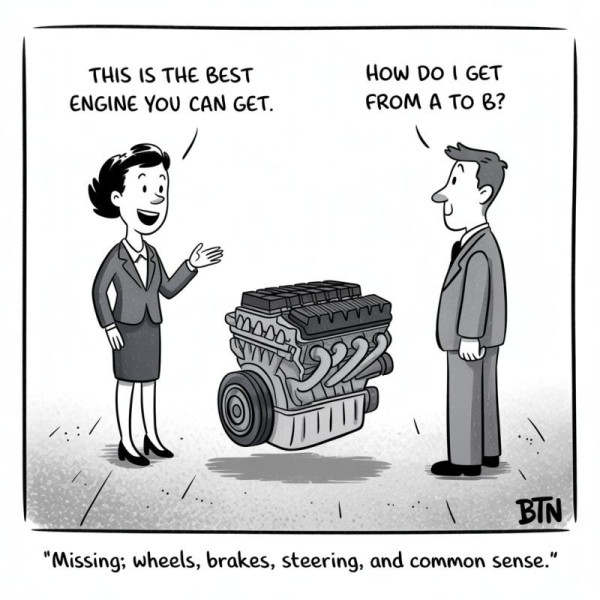
If AI is the engine, content ops are the car that makes it move. Without the car, the engine is useless. (credits)
Even the most advanced AI only creates real business value when supported by clear ownership, strong processes, and governance.
If you don’t, you just slam on AI as an experiment and miss out on its real power.
ROI for content ops and AI
I manage all content on thinklikeapublisher.com and the distribution on social, in just 8h a week – while reaching over 100+K readers a year, 42+K unique visitors a year, and 2.100+ subscribers.
How I use AI:
- In the research and reviewing phase only
- I still think, write, and design my copy by hand
For me, that's faster, keeps quality high, and ensures an optimized reading experience.
First, a quick breakdown of content operations, followed by 3 tips.
Content operations is brand control, speed to market, ROI, and managing risks
It’s not ‘just a process’. It's the backbone of your content marketing, making it possible to turn your content strategy into measurable, consistent execution. Covering workflows and production-to-approval processes, rules to ensure ethical use and data protection, guidelines for brand and quality control, plus a measurement and reporting framework.
Not the least, content ops also help you in proving ROI instead of being a black hole. Built-in reporting from the start, so it’s easier to get insight into the results. Besides, this also helps you prevent creating content that will not have any impact.
→ There is no such thing as a universal model for content ops, it’s bespoke and depends on your maturity, scale, and team.
But there are a few tips that you can apply immediately.
Tip 1. One owner owns processes and manages projects
This seems obvious, but in reality, it’s often scattered. Usually, content ops and quality assurance (QA) are the end responsibility of the CMO or Marketing Director. But, in fact, the operational work should be in the team, with someone who has the knowledge, experience, and time.
- One is responsible for developing, gathering feedback, and improving processes to prevent inconsistencies in ways of working, frustrations, and unnecessary delays.
- This person also keeps the overview of priorities, manages the project, and ensures that there’s long-term planning so you can produce content in batches and two weeks in advance, so the team gets the necessary headspace to remain creative.
- He or she is also responsible for the final quality control. And has the power to say ‘no’. ‘No’ if the quality is not good enough, but also ‘no’ to requests from within the company if there’s no clear ROI or business case for the content request.
Tip 2. AI: design your content production process around it
If you really want to take advantage of AI to lower costs and get higher quality content at a higher speed, you need to rethink the content production processes. Without operational clarity, AI just makes bad content faster.
AI has moved from experiment to standard practice. It’s not just using ChatGPT or CoPilot to do tasks for you. You have to design your content production process around AI.
Decides how (and if) AI gets integrated:
- Where AI accelerates: drafting, repurposing, formatting
- Where humans are essential: brand voice, judgment, compliance
- How to maintain quality, ethics, and accountability when content scales x10 with AI
How that should look differs from company to company and team to team. There’s no proven setup yet. It depends on your company culture, your industry compliance and regulations, your tech stack, and AI maturity in the team.
Tip 3. Create ethical and quality guidelines
To test your content rigorously on ethics and compliance to prevent online manipulation and exclusion. And bake this into your process, from start to end. Ask the hard questions. Be fully transparent on which customer data you use.
Did you know that
- There can be fines up to 7% of global revenue (EU AI Act, 2026): any AI you use must be transparent, governed, and ethically applied
- 44% of AI systems show gender bias, and 25% show both gender and racial bias
- Targeting and hyper-personalization can unintentionally shift from persuasion to online manipulation and exclusion
And it's the owner, see tip 1, who checks, notifies, and has the mandate to say ‘no’.
Frequently asked questions about content operations
- How do I stay consistent and scale content without burning out my team or budget?
Most strategies fall apart after a few months when processes loosen, ownership is unclear, and production gets chaotic with ad hoc output.
Content ops fixes this by embedding governance, reuse, and clear workflows so consistency is baked in, and scaling doesn’t mean more spend or exhaustion.
- How can I use AI at the core of content operations without risking brand voice or compliance?
AI patched onto broken workflows just creates faster chaos. The key is embedding AI into the content engine itself: clear roles for humans versus machines, governance for compliance, and rigorous testing for voice and quality.
Done right, AI accelerates consistency and savings, not risk.
Summary: cost savings and 3 tips
If you’re serious about cost savings, and you are, look at your content ops first before you look at AI. You have to get the basics in place before you can scale and accelerate.
Most projects launch with energy but stall without structure. You end up back where you started, because nothing really changed.
Setting up your content ops is bespoke; there’s no universal framework or setup. That said, there are 3 tips
- One owner owns processes and manages projects
- AI: design your content production process around it
- Create ethical and quality guidelines
Now it’s up to you.
And if you need any help, feel free to contact me. I’ve done this multiple times, and thinklikeapublisher.com is my test lab: 2,100+ subscribers, 42,000+ annual visitors, and 100,000+ annual readers. All built and managed in 8 hours a week.
Read more ‘How to build content operations that scale trust, not your chaos: Protect what AI can’t’
If you want real ROI from AI, don’t chase prompts. Build the system. This book gives you what you need to make AI safe, strategic, and scalable without losing what made your content great in the first place. Now for just $ 4.99 on Kindle.
At the core is the content ops threesome™, a three-part framework
- Your brand voice — so tone drift doesn’t quietly erode trust
- Your data — so prompts don’t turn into privacy risks
- Your team — so no one’s left navigating AI in silence, fear, or burnout
You’ll learn how to replace AI chaos with clarity — using real operational steps, not tool hacks or vague inspiration.
→ How to build content operations that scale trust, not your chaos: Protect what AI can’t
Stay ahead on marketing, content, and AI with insights that actually matter
Get real, practical insights on AI, content, and trust, straight to your inbox, once a week. Unsubscribe anytime. No hard feelings.
Simple as that.
 Powered By PressPage