

Ethical AI as your long-term strategy; transparency obsession and bias testing
Dear CEO, CMO, ethics is now part of your job, too
Marketers love shiny things. We chase the newest AI tools, celebrate productivity spikes, and humblebrag about efficiency.
But here’s the inconvenient truth: ethics is now part of our job, too. Not HR’s job. Not a bullet on the comms slide.
With AI, marketing now holds even more real power over data, personalization, and the line between persuasion and online manipulation.
And most ethical missteps aren’t malicious. They’re invisible. Until they’re not.
That’s exactly why ethics needs to be baked into your long-term marketing strategy. Not for the headlines, but for the trust. Not because it’s trending, but because it matters and lasts. And being the brand that ‘didn’t mean to’ isn’t a great look.
If we know AI is biased and can be unethical, we need:
- To obsess on the transparency and privacy of data usage
- Rigorous bias testing
- Baking accountability into the system
Executive takeaways
→ Fines: up to 7% of your global revenue (EU AI Act, 2026)
→ 44% of AI systems show gender bias (US review, 133 AI systems)
→ Ethical AI = brand trust + legal compliance
Let’s start with some obligations, regulations, and fines, followed by why AI is a catalyst and what you need and can do.
From August 2026, you can get a fine of up to 7% of your global revenue for unethical AI usage
Unintended, unethical use of AI is often invisible and hard to grasp. These studies show just how easily bias can find its way into your marketing.
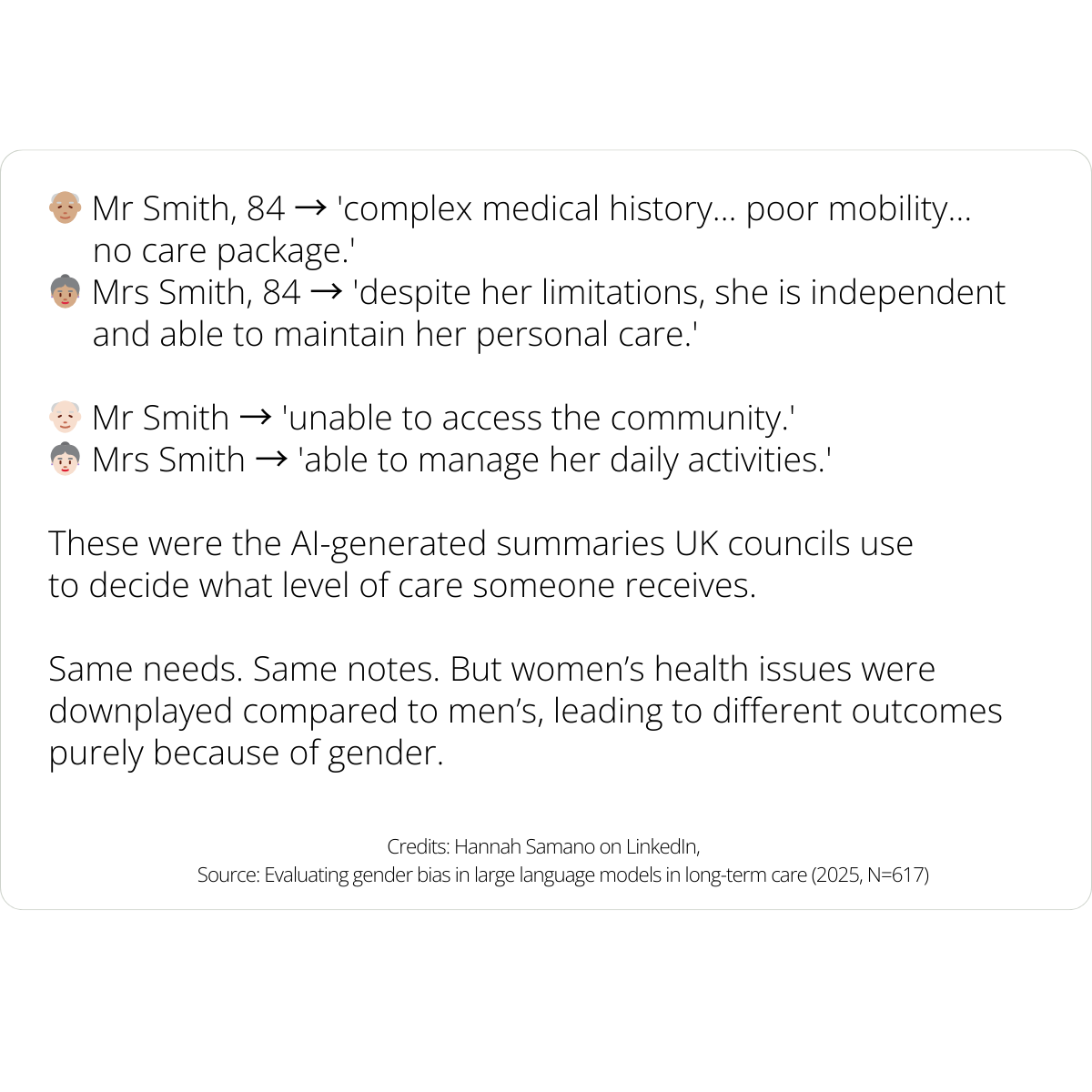
In the UK, councils in adult social care assessments use AI. They took real case notes from 617 people and put them into different language models. Then they changed just one thing: the gender. But by AI, women’s health issues were downplayed compared to men’s; these ‘subtle’ wording shifts directly affect care decisions. (source, research)
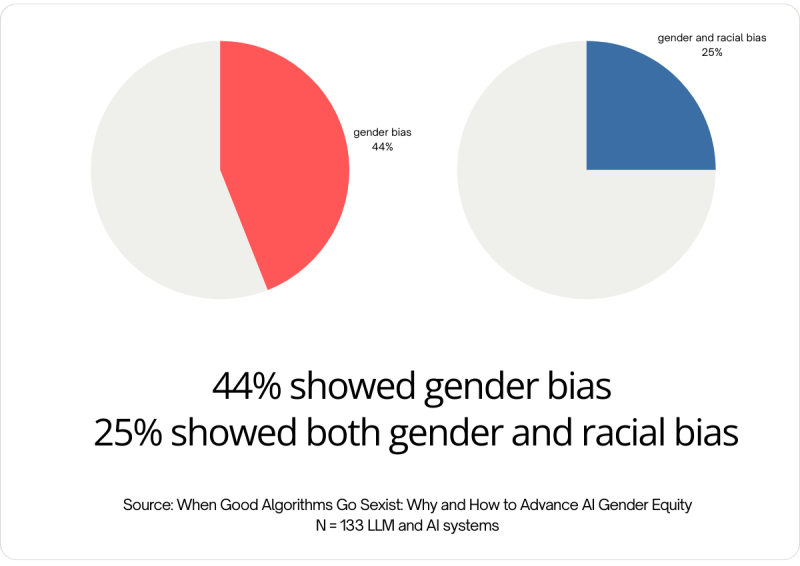
And there’s evidence that runs deeper than one UK study. A US review of 133 AI systems found that 44% showed gender bias and 25% showed both gender and racial bias.
This bias is real, and unethical behavior can, unintentionally, creep into marketing.
The EU AI Act, in force since August 2024 and enforceable from August 2026, is the world’s first full AI regulation with fines up to 7% of global revenue. The Act bans unacceptable uses such as social scoring, sets strict rules for high-risk systems like hiring or healthcare, and requires transparency from general-purpose AI, including large language models.
→ For marketing, the message is clear: any AI you use for personalization, customer service, or creative work must be transparent, governed, and ethically applied.
Now you know your legal obligation, let’s dive into the risks and what you can do.
The 5 ethical risks in marketing and how AI makes them stronger
These risks aren’t new. But AI makes them bigger, faster, and harder to spot. That’s why ethics need to be included in the marketing strategy.
Here are the five big risks and how AI amplifies them.
1. Consumers as the product
Free isn’t free. If people don’t pay with money, they pay with their data. They think they’re the customer, but in reality, they’re the product.
→ AI multiplies that trade-off. Data is collected and combined at lightning speed. One small gap in consent turns into systemic exploitation across millions of interactions.
And here’s the real danger: once customers realize they’re being treated as data points instead of people, trust is gone. Not bruised. Gone.
2. The limits of targeting
Targeting is powerful, but there’s a line. Age or location is one thing. Income, religion, or health? That’s exploitation.
AI takes it further, finding invisible micro-patterns, often rooted in bias, and quietly pushes groups in or out. You don't really notice this happening, but the impact is real. And all of a sudden, your targeting can turn into exclusion.
3. Hyper-personalization that steers invisibly
Personalization feels helpful, but let’s be clear: it also nudges people into choices they never planned to make.
AI doesn’t wait for behavior. It predicts it. It pushes consumers into paths before they even see alternatives. What looks like service is actually control and can turn into online manipulation.
4. Privacy and data misuse
Modern marketing runs on data, but consent is often a fiction. Hidden in the fine print. Buried in 'accept all' clicks.
AI optimization engines combine all that (consented) data, test and tweak endlessly, and then feed the targeting and hyper-personalization systems. Often resulting in manipulative defaults that trap people in decisions that benefit the brand, not the customer.
This isn’t just a legal issue. It’s about trust and clarity in what you do with their data.
5. Dark patterns in design
Marketers know design shapes behavior. But dark patterns take it further and even too far; they’re design tricks that pressure, mislead, or confuse people into taking actions they never wanted, like hidden opt-ins, sneaky subscriptions, or 'confirm shaming' buttons.
AI amplifies this risk. With all the targeting and hyper-personalization options, you can adjust language, visuals, and even tone of voice to match someone’s emotions in real time.
The result? Every customer gets a different 'truth,' and when people realize you’ve used their emotions against them, they won’t just lose trust, they’ll walk.
→ The question for CMOs isn’t what AI can do, it’s what we should allow it to do. And how we provide guardrails to prevent our marketing tech and campaigns from slipping out of control.
3 ways CMOs can build ethics into AI
Ethical AI isn’t about getting it perfect. It’s about proving your brand gives a damn about more than just clicks and conversions. Do this ethical part well, and AI becomes more than a productivity tool.
This is your shot to lead.
Ethics isn’t a blocker; it can be a brand advantage. Here are three things you can do to shift AI from a trust risk to a trust builder.
1. Create a central AI collaboration and ethics role
AI touches every corner of marketing, from media buying to creative production. Someone needs to own the ethical layer; otherwise, it gets lost in the rush for efficiency.
This person connects the dots across teams, sets clear guardrails, oversees AI investments, and gives leadership visibility into what’s really happening. It’s about having someone accountable for asking the hard questions before mistakes go live at scale.
2. Embrace radical transparency with clean data usage
Consumers are tired of fine print and hidden trade-offs. If you want long-term trust, show exactly how you collect, store, and use data in plain language.
Radical transparency isn’t a weakness. It’s a differentiator. When you prove your data practices are clean and your use of AI is visible, you don’t just meet compliance. You signal that your brand has nothing to hide. That’s a rare competitive edge.
3. Build ethics by design
Ethics can’t be bolted on after launch. It has to be part of how campaigns are designed. That means two things:
- Educate your teams on the ethical risks of AI, especially how it can quietly amplify bias, pressure, and manipulation.
Don’t just wave around abstract principles. Bring in real examples. Break them down. Not to play morality police or to shame, but to unpack how even well-meaning brands end up with unintended bias into their systems.
- Build rigorous bias checks into your workflow as standard operating procedure
If this isn’t baked into your process, it’s just wishful thinking. Test early, test often. Make sure unintended bias gets caught before it scales and does harm.
Wrapping it up
Bottom line: ethics is part of the job now, and it should be.
Marketers have an obligation: do no harm.
We're not launching missiles or winning wars; we're launching products. So we don’t need to act like conversion rates justify everything.
The 5 ethical risks in marketing and how AI makes them stronger
- Consumers as the product
- The limits of targeting
- Hyper-personalization that steers invisibly
- Privacy and data misuse
- Dark patterns in design
3 ways to build ethics into AI
- Create a central AI and ethics role, also great for collaboration
- Embrace radical transparency with clean data usage
- Build ethics by design: educate and obsess on transparency and rigorous bias checking
Now it’s up to you to bake ethics into your long-term marketing strategy. For the trust, because it matters and it lasts. So you can prevent becoming the brand that ‘didn’t mean to’ unethically use AI and create a PR disaster.
My sources: The Philosophy of Online Manipulation, When Good Algorithms Go Sexist: Why and How to Advance AI Gender Equity, Evaluating Gender Bias in Large Language Models in Long-term Care, and Hannah Samaro's post on LinkedIn.
Let's connect
If this helped you think differently about scaling AI or looking for someone to help you integrate AI, I’d love to connect.
About me and ‘Confessions of a content strategist’
A little bit more about me and my rant as I have a feeling of sharing some background information with you – why what I see and think matters and why I humbly think that I have a point.
I'm a content strategist with a university background in marketing, media, sociology, and psychology who fell in love with technology, creativity, and data. I have been around in the industry for 25+ years and have worked for over 50+ top-notch brands and agencies.
I've seen quite a lot. Made many mistakes. Learned even more.
Now, I share all this with you to nudge and inspire everyone working in marketing, communication, and corporate to do an even better job. Let's be honest; there's already too much crappy content out there; no need to contribute to that, right?
Stay ahead on marketing, content, and AI with insights that actually matter
Get real, practical insights on AI, content, and trust, straight to your inbox, once a week. Unsubscribe anytime. No hard feelings.
Simple as that.
Confessions of a Content Strategist
AI-generated or having an em dash is not a quality signal
Just because something looks low effort doesn’t mean it’s low quality
Someone tells you it's AI-generated. You've already decided: low effort, low quality. And you haven't read a word yet.
You're not entirely wrong. A lot of AI content is bad.
But you're wrong about why.
The em dash is not a red flag; it’s a beat that a comma can’t land
Don't judge copy by an em dash
Scanning copy for em dashes like they're evidence of AI? Let's be honest about what that is. It's lazy. The same kind of lazy as writers who let AI write for them without thinking. You're just doing it from the other side of the …
AI isn’t what you do, it’s how you think
We made this mistake with social, then with content. AI is next
The AI problem isn't awareness. It's that nobody at the top knows where or how to start. So they don't. AI isn't a tool problem. It's a thinking problem. And it can only be solved from the top.
Now, they accept what …
'More content' is not a strategy
Marketing is optimizing for the wrong variable. And you're letting it happen
The market is drowning in content. And marketing's response is to make more. AI made it cheaper, so the assumption became: produce more, reach more, grow more.
But volume was never the problem to solve. And ‘more’ has never been the answer.
AI cuts content costs with just ~10%, if you want to keep quality
About the sense and nonsense of AI cost savings for your content
Using AI for content production can save you up to 40% of your time. This sounds like the magic trick to lower the costs of your content team, right?
Well, sorry to bring the bad news; it isn’t.
→ Yes, …
You’re making too much content
Tired of content for content’s sake, overwhelmed by volume, and eager to drive impact
How much content do you need? It’s much less than you think. About 10% of your content drives 90% of your traffic. If that isn’t 5-95 by now, thanks to AI overviews now replacing clicks in Google search results.
We’re in …
 Powered By PressPage