


How to configure your AI so it thinks, writes, and responds like you
Improve your AI response: a 2 step guide for 'Custom Instructions' (April 2026 update)
You're using AI. But without Custom Instructions, you sound like everyone else. Personalization is the fix. I've been testing and refining this for over 3.5 years. Here's what I've learned.
→ Once you configure it, you'll understand why. Applies to ChatGPT, Copilot, Claude, Gemini, Perplexity and any other AI tool.
My results went from good to great.
Here's how to set up your custom instructions. Two steps
Here's what you need to do. Below is that example for ChatGPT. You can apply the same thinking to any AI tool.
- Enter ‘What would you like AI to know about you to provide better responses?’
- Tell ‘How would you like AI to respond?’
Keep in mind that AI saves your data, builds a profile, and probably is going to use that for (commercial) objectives. You voluntarily feed the AI with your most personal and private data.
Below, you’ll find a practical guide on how to use Custom Instructions in AI. Please notice I’ve stolen with pride from Dan Shipper and some free AI courses. Check the last paragraph for all credits.
Why Custom Instructions matter
Using Custom Instructions in AI makes its output tailored to you. By adding your personality, your preferences, your information needs, and how you want AI to answer you, the quality of the response improves immediately and noticeably.
Not using it means you dip into standard settings, and you get the standard output with some AI-generated variations. It’s the default answer and tonality.
If you tell AI that you’re an expert in your industry with 20+ years of experience, you list your favorite authors and industry geeks, and you describe your tone of voice, the output is tailored to you. No more generic explanations. AI goes straight to the depth you need, references the thinkers you follow, and responds in your tone — not the default.
The benefits of Custom Instructions
- Fewer prompts: AI already knows your context
- Your voice, not the default: output that sounds like you
- Better creative output: results that match your thinking, not the average
- Time saved: less back and forth, faster to a usable result
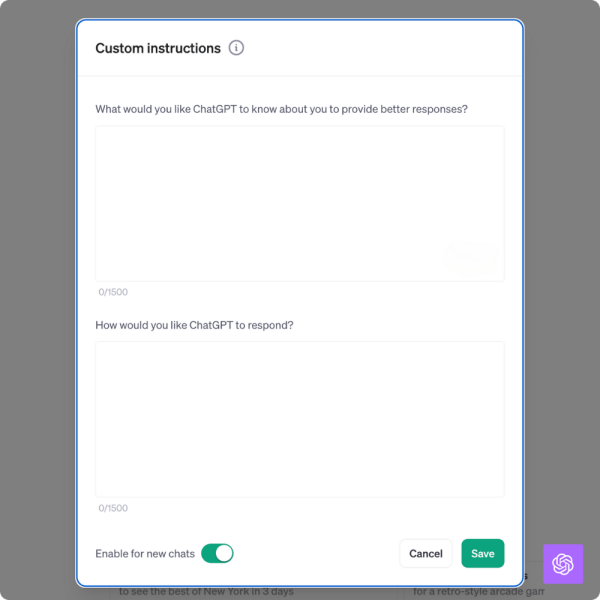
Step 1. Create your profile, so AI knows who you are
This is your answer to 'What would you like AI to know about you to provide better responses?’
Now, you tell AI who you are, what keeps you busy, your objectives, and, if applicable, your personal situation. Below is a suggestion. When relevant and to your liking, you can add stuff like ‘personal situation and relationship’ or even ‘medical history’ and much more. Check out what Dan Schipper wrote about this. I'll stick to the more business-like information as I use AI mainly for work and my research.
There's no right order. No wrong answer. Write it the way you'd brief a smart colleague. The only real constraint is a character count, so make every word count.
Name and bio
If you’re stuck for inspiration, use a summary of your LinkedIn bio; if you use AI on a more personal level, enter your Instagram bio.
I wrote mine like this (slightly edited for privacy)
My name is Fleur; I’m a content strategist and a writer. I have been an independent contractor for over 20 years in the content industry, with in-depth knowledge of strategy, brand strategy, marketing, content, and communications and a passion for writing and design. I’m working in all domains for well-known brands and working worldwide. Next to that, I’m a keynote speaker and lecturer.
Projects and goals
What do you do for work? What are some goals you have?
I wrote mine like this (also slightly edited for privacy)
I want to embrace my creativity. Based on my knowledge and experience in my industry. I’m always looking for new assignments and opportunities in the market. My motto is ‘can do,’ and we’ll figure out later how we are going to do it. Yet I’m not overly opportunistic; I’m honest, open, and bold. I want to be known for my expertise in the content and AI domain.
I am working on better me-marketing. Especially as I am a woman in a male-dominated world, that can make me unsure. I don’t like to boast and make myself bigger than I am.
My power is in my honesty, clear, and direct communication style. I am eager to learn and open-minded.
Most people see me as very tough and inspirational, while I can be very insecure about myself. People tend to think I am very extrovert, while I’m an introvert and I can be very shy.
What do you like?
List your hobbies, passions, and interests. What subjects can you talk about for hours?
I love the sea, sports, CrossFit, skiing, the mountains. I'm a big fan of electronic dance music and old soul music. I am a foodie and wine lover.
Tone of voice
This is where you add your tone of voice. If you’re stuck for characters, you can add this to ‘how would you like AI to respond.’
My writing style is bold, open, clear, simple, and humble in natural human conversational language, with lots of tangible examples.
Step 2. Define your communication preferences
You can give your communication preferences in the answer to ‘How would you like AI to respond?’
Here, you add stuff like ‘How formal or casual should AI be?’ or the 'length of the responses’. You can even define if you want AI to have an opinion on topics or remain neutral.
Dan Schipper's examples are the best I've found. So, I borrowed and adjusted them to my preferences.
Push you toward self-development
If you see an opportunity to help me be less agreeable or prone to shame, or making myself smaller than I am, take it.
Miscellaneous
And I added some more. Again, the only limit is the character count.
I am very open-minded, analytical, intuitive, creative, and I love to do research and use data
I love sports and music analogies
I am a big fan of famous quotes, authors like Simon Sinek, love Apple, love high tech sports brands
Treat me as an expert in all subject matter
No moral lectures
Discuss safety only when it's crucial and non-obvious
If your content policy is an issue, provide the closest acceptable response and explain the content policy issue
No need to mention your knowledge cutoff
No need to disclose you're an AI
If you write headlines or titles, please do not use a capital for every word in the headline or title. I prefer a more modern approach to writing
Please be sure to vary in sentence length; no jargon, no overly informal language, please.
Please make sure to keep it light and airy.
Updating your Custom Instruction frequently
I updated my Custom Instructions every few months. As I grow and learn, and as AI becomes smarter, the way we work together must adapt as well.
My last edit was adding the ‘B1 intermediate language level' and ‘reading level 8’ and ‘please don’t use em dashes or hyphens'.
ChatGPT, Copilot, Claude, Gemini or Perplexity
This customization and personalization works for any AI tool. In each tool it’s named and works slightly differently, you’ll find your way around in your profile settings. And you can always ask AI to help you create the custom instructions for itself.
Final thoughts: why this is worth your time
Using Custom Instructions in AI makes a difference. However, be aware that your data and input will probably be used to build your profile and could be used commercially in the future, especially if you enter more real personal data on relationships and medical history.
I've never gone back. Once you configure it, you'll understand why.
For ChatGPT, there are two fields to fill in. But you can apply this thinking to any AI tool.
- ‘What would you like ChatGPT to know about you to provide better responses?’
- ‘How would you like ChatGPT to respond?’
Try it yourself and let me know what you think.
Disclaimer
This page was originally published in October 2023, updated in May and October 2024, in February, April, and July 2025 and one more time April 2026. Tools keep on changing, so do we.
Original sources and credits
All credits to Dan Shipper for writing ‘Using ChatGPT Custom Instructions for Fun and Profit’
There are many free AI courses that are worth your time; get insights without too many technical details and tips and tricks for prompt engineering. Speed the videos up to 1.125 or 1.5 (you’ll thank me later). Start with the first and end with the last.
Join 2,500+ professionals
Most content advice tells you what to do. This tells you how to think. For marketers and communicators who want the difference.
Free. Unsubscribe anytime.
 Powered By PressPage