


2027 pulls two ways: deeper into AI, hungrier for human connection
Our split love is defining what comes next
Something is happening as AI becomes more normal: the more we use it, the more we seem to crave everything it can’t give us.
We want AI to take on the heavy lifting, help us move faster, and let us do things we couldn’t do before. But that comes with a fear of being replaced, pressure to become AI-literate, companies automating work, and a growing sense that opting out isn’t really an option.
At the same time, we crave the opposite: offline time, analogue experiences, real relationships, craftsmanship, imperfection and humour. A way to step away from an increasingly generic, algorithmic online world.
That tension is going to define 2027.
There’s no going back on AI. The question is what we do with it.
Use it simply to make more, faster and cheaper, and we’ll drown in increasingly efficient sameness. Use it to expand what people can create and spend the time it gives back on craft, creativity and connection. And things will get much more interesting.
Why it matters
We need each other. Craft without AI stays small. AI without craft is slop.
AI is here to stay, so we better learn to deal with it. Four years in, the hype and the mystique are gone. AI is just part of daily work now. What hasn't caught up is us — we're still learning how to talk to machines.
Most people meet that with fear: AI will replace me. That's the wrong response. The right one is doubling down on craft and creativity, using AI to accelerate it, doing what wasn't possible before, and freeing up time for real, offline connection.
Skip that, and the slop grows exponentially. Algorithms keep feeding more of the same until everything turns generic.
→ Obsess over craft and creativity, and dare to be different. Or everything starts to look the same.
3 things that are happening:
- AI earned its place to do what humans can't
- Analogue rise because of AI
- Recognizable human and humor, because of creativity
What to do from a brand's perspective: don't use AI as an excuse to cut costs
Most companies aren't afraid, they're doing the maths. Cut a part of the team, or keep the team and make them produce more of the same, faster — which feeds the slop. Leadership sees savings; the people see their jobs in danger.
→ Instead, redirect the freed up time toward human craft and analogue reconnection.
There's an older problem underneath this one. AI is moving through companies the way social media and content did — hyped, fast, everywhere, and owned by no one. No single leader owns the overarching view.
→ The brands that win in 2027 won't use AI to do more of the same, but cheaper. They'll use it to become better and, as a result, more profitable. The biggest gamechanger? They'll put one person in charge of AI, with stakeholders in all domains.
From a human perspective: double down, don't defend
Fear makes people defensive — protect the job, prove you're still needed, keep pace with every new tool.
→ Update your mindset and stack your skills.
First, improve your quality. Invest heavily in your skills. Skills in your craft. And skills in learning how to talk to machines and integrate AI into your daily work. AI is not a fancy search engine or a dumb assistant you can boss around. It's a smart, eager coworker who's available 24/7 and always happy to help.
Then, use AI to do what you alone couldn't do before. Because you improved your skills first, the output when working with AI will be better, faster, and at scale. And the time that AI gives back to you? Spend it again where AI can't follow you — on your craft, your point of view, your creativity. And invest it in real, analogue relationships.
→ The people who matter in 2027 aren't keeping up with AI. They're using it to buy back time — then filling that time with something unmistakably theirs.
Five examples
Explained by example, all 5 are the winners at Cannes Lions in 2025 and 2026.
Claude Film, “Can I Get a Six Pack Quickly?” and “How Can I Communicate Better With My Mom?”
It didn't just use AI, it made an argument about it. Two Anthropic Super Bowl LX spots, released days before the game, timed right after OpenAI announced it would start running ads. (Six Pack video, Communications with Mom video)
The spots make fun of AI assistants that answer badly, positioning Claude as the sharper alternative the moment the market's biggest player entered advertising.
Won Film Grand Prix plus Gold, Silver Film, Silver Creative Strategy. Mother London, dir. Jeff Low, Biscuit Filmworks
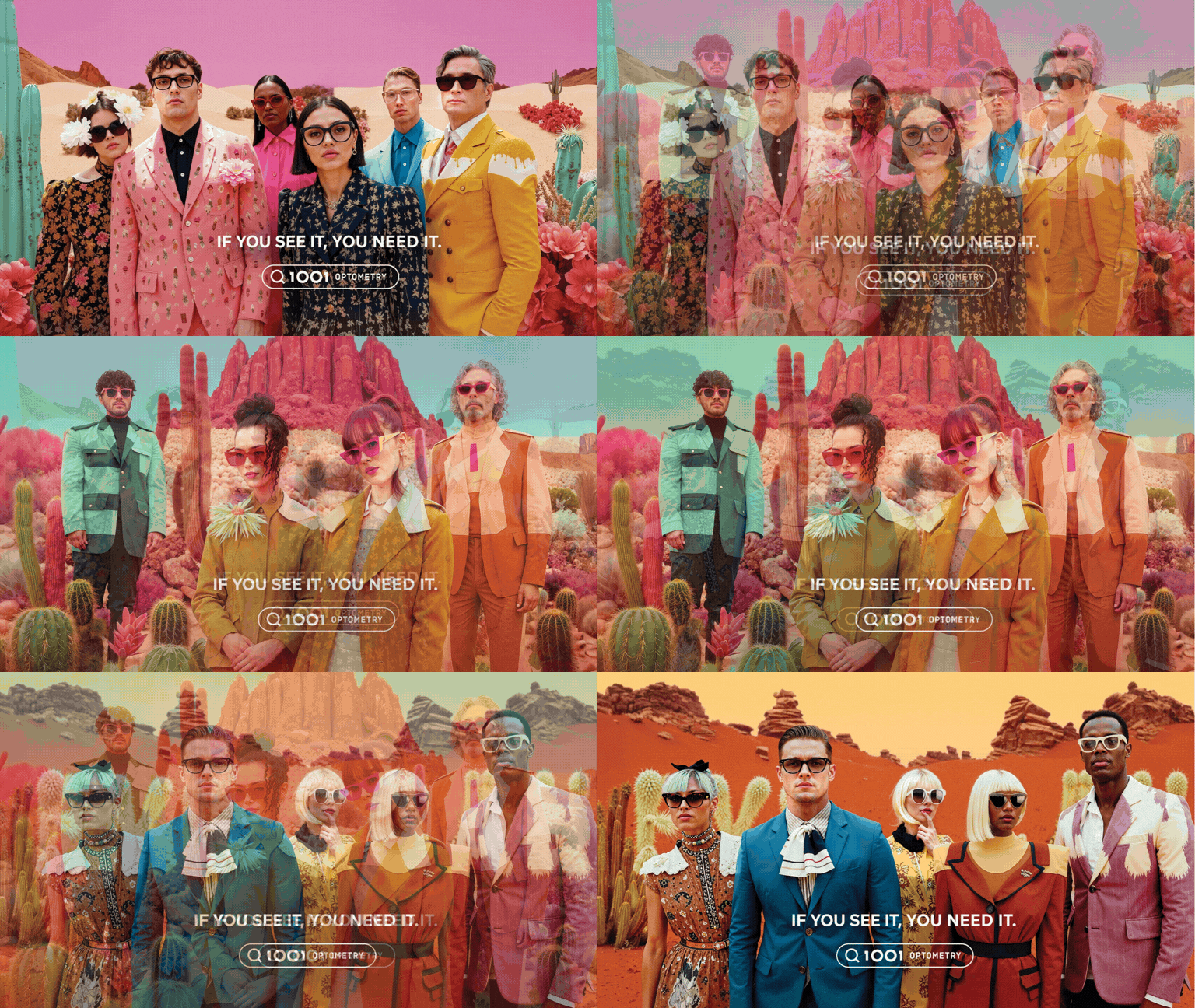
1001 Optometry, “The Hidden Eye Test”
It's AI engineering a test that only impaired vision could pass. The insight: most eye tests are built around what you can't see. This campaign flipped it.
Billboards and visuals, crafted with AI-designed color, contrast, and composition, hid phrases like “eye test” or “eyecare” inside high-fashion imagery — visible only to people with certain vision impairments. Spotting the hidden message was the diagnosis.
A year of R&D with AI artist Prospex Park, blending AI tools with traditional Photoshop technique. VML — Gold Lion, Cannes 2025
Heineken “Could Have Been a Heineken”
A digital mechanic that pays off in an analogue reward, poking fun at recognizable, annoying rambling voice notes: send one over three minutes long, get a free beer, redeemable only in person, only after listening to it together. Turned 280 hours of voice notes into real-world meetups.
LePub Milan & LePub São Paulo — Grand Prix, Social & Creator
AXA France “Three Words”
Unmistakably human. Add three words — “and domestic violence” — to standard home insurance contracts, so a policy that already covered emergency relocation for fire or flood now covers it for domestic abuse too. Survivors get immediate legal, psychological, and emergency housing support, built into the product itself. Care engineered into fine print.
Publicis Conseil, Paris — Titanium, Direct, and Creative Business Transformation Grand Prix in 2025; Creative Effectiveness Grand Prix in 2026 for sustained impact
KitKat “The KitKat Heist”
Zero AI involved. Humor and creativity, full stop. A truck carrying 12 tonnes of KitKat, 413,793 bars, hijacked between Italy and Poland a week before Easter. KitKat leaned into its own playful identity instead of going defensive: $224 million in earned media in 10 days on zero spend, 31% share of voice across 93 markets, 115+ brands joining the joke.
Burson, VML, London — PR Grand Prix plus four Gold Lions
Sources
Cannes Lions, Love the Work, Adweek, LBB online, Contagious, Roastbrief US, Advertising Week, The Drum, Campaign Live, Creative Review, WARC, VML, Insight News, Adweek (Heineken), Contagious (Heineken), WARC (AXA), AdAge (AXA), AdWeek (AXA), What’s Trending (KitKat), Burson (KitKat), WARC Lessons from Cannes 2026, WARC KitKat Heist, Behind the Scenes with Cannes Jury, AXA wins in Cannes, For all my insights on AI, the list of sources is endless.
Join 2,750+ professionals
AI changes how the work gets done. I test it in my own work and write about what actually works.
Free. Unsubscribe anytime.
 Powered By PressPage