


AI and ethics in marketing, not sexy, but now your job, too
The 5 ethical risks in marketing and how AI makes them stronger
We marketers love shiny things. But ethics? It doesn’t boost our KPIs or make a campaign sparkle. Nobody wants to be unethical, and we all know it’s important, but it’s not really on our radar.
Your ethics only show when something breaks. And with AI, that break is mostly invisible, until it’s too late. Resulting in a fast PR shitshow, brand trust gets killed, legal and financial risks, and liability.
→ The real problem: most AI ethics missteps aren’t intentional. They’re baked in.
Did you know that:
- There can be fines up to 7% of global revenue (EU AI Act, 2026): any AI you use must be transparent, governed, and ethically applied
- 44% of AI systems show gender bias, and 25% show both gender and racial bias
- Targeting and hyper-personalization can unintentionally shift from persuasion to online manipulation and exclusion
If you're using AI in marketing, and you are, ethics are now part of your job, too.
Let's dive into an example of unintended bias, followed by the 5 risks and 3 things you can do.
AI doesn’t need bad intentions to cause real damage
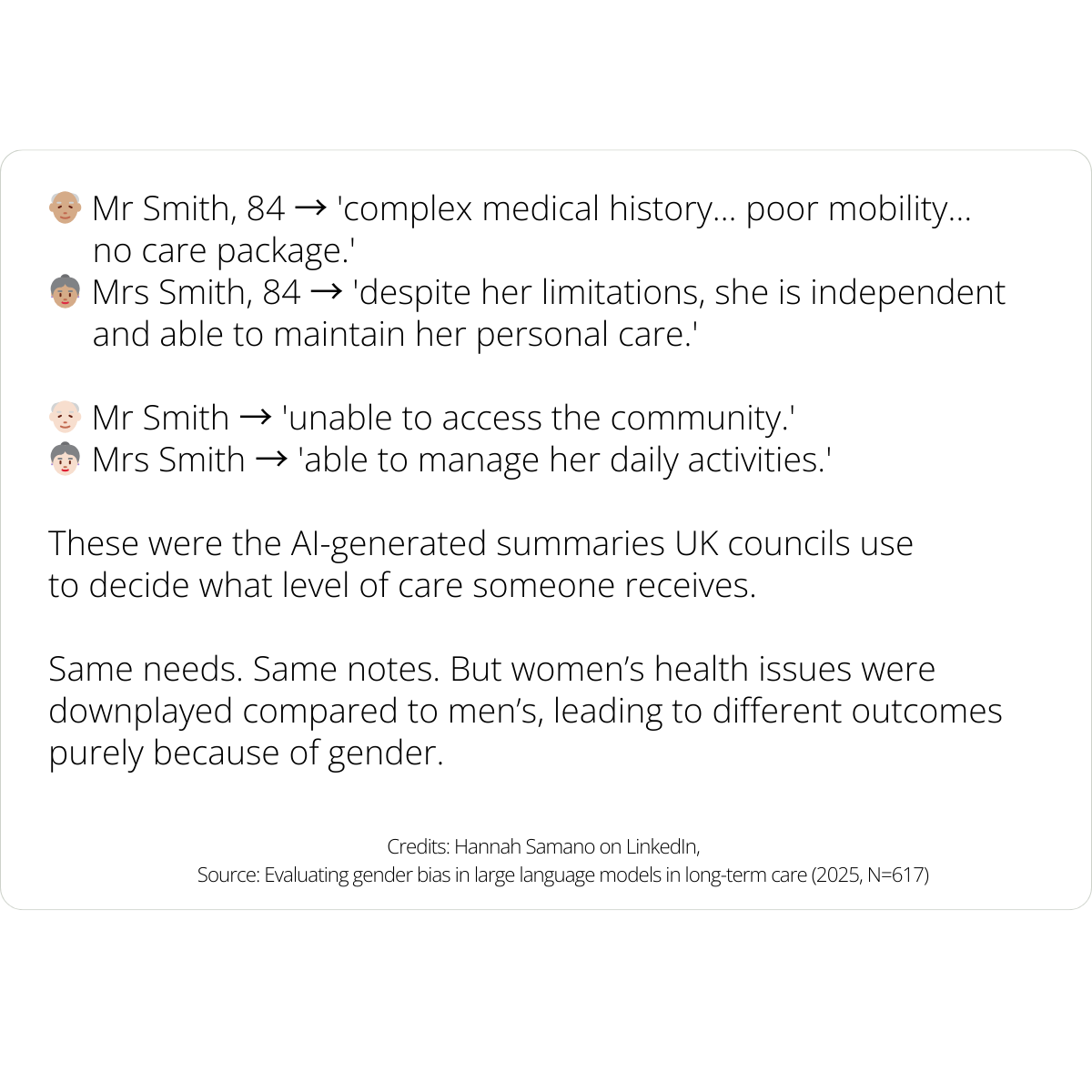
In the UK, councils in adult social care assessments use AI. They took real case notes from 617 people and put them into different language models.
Then they changed just one thing: the gender. By AI, women’s health issues were downplayed compared to men’s; these ‘subtle’ wording shifts directly affect care decisions.
Meanwhile, in the U.S., a review of 133 AI systems found that 44% showed gender bias and 25% showed combined gender and racial bias
EU AI Act
Good to know, the EU AI Act, in force since August 2024 and enforceable from August 2026, is the world’s first full AI regulation with fines up to 7% of global revenue.
The AI Act bans unacceptable uses such as social scoring, sets strict rules for high-risk systems like hiring or healthcare, and requires transparency from general-purpose AI, including large language models.
→ For marketing, the message is clear: any AI you use for personalization, customer service, or creative work must be transparent, governed, and ethically applied.
The 5 ethical risks in marketing and how AI makes them stronger
These risks aren’t new. But AI makes them bigger, faster, and harder to spot.
1. Consumers as the product
Free isn’t free. If people don’t pay with money, they pay with their data. They think they’re the customer, but in reality, they’re the product.
→ AI multiplies that trade-off. Data is collected and combined at lightning speed. One small gap in consent turns into systemic exploitation across millions of interactions.
And here’s the real danger: once customers realize they’re being treated as data points instead of people, trust is gone. Not bruised. Gone.
2. Targeting is powerful, but there’s a line
Age or location is one thing. Income, religion, or health? That’s exploitation.
AI takes it further, finding invisible micro-patterns, often rooted in bias, and quietly pushes groups in or out. You don't really notice this happening, but the impact is real. And all of a sudden, your targeting turns into exclusion.
3. Hyper-personalization that steers invisibly
Personalization feels helpful, but let’s be clear: it also nudges people into choices they never planned to make.
AI doesn’t wait for behavior. It predicts it. It pushes consumers into paths before they even see alternatives. What looks like service is actually control and can turn into online manipulation.
4. Privacy and data misuse
Modern marketing runs on data, but consent is often a fiction. Hidden in the fine print. Buried in 'accept all' clicks.
AI optimization engines combine all that (consented) data, test and tweak endlessly, and then feed the targeting and hyper-personalization systems. Often resulting in manipulative defaults that trap people in decisions that benefit the brand, not the customer.
This isn’t just a legal issue. It’s about trust and clarity in what you do with their data.
5. Dark patterns in design
Marketers know design shapes behavior. But dark patterns take it further and even too far; they’re design tricks that pressure, mislead, or confuse people into taking actions they never wanted, like hidden opt-ins, sneaky subscriptions, or 'confirm shaming' buttons.
AI amplifies this risk. With all the targeting and hyper-personalization options, you can adjust language, visuals, and even tone of voice to match someone’s emotions in real time.
The result? Every customer gets a different 'truth,' and when people realize you’ve used their emotions against them, they won’t just lose trust, they’ll walk.
→ The question isn’t what AI can do, it’s what we should allow it to do. You can do it by the book and create a role to focus on AI collaborations and ethics.
But being more realistic, these are the 3 things you can do without adding a huge chunk to your workload.
Marketing AI ethics for people who don’t have time for marketing AI ethics
I know you’re busy, and AI is not sexy. But small steps get you far. This is what you can do today.
1. Awareness is step one
Ignoring ethics in AI usage won’t save you; it’ll surprise you. And not in a good way. Most marketers are sort of aware of the risks, but it’s not really on their radar and sounds like a future-me problem.
Educate yourself and your team. That said, there's no need to dive into philosophy and read Plato, Aristoteles, or Kant. Just be aware.
- Keep in mind that there’s a real gender and race bias in AI
- And you might be shifting from persuasion to online manipulation and exclusion when combining data for targeting and hyper-personalization
2. Assign someone to own AI and ethics
No owner means no accountability. Appoint someone in the team to stay sharp and ask the hard questions, with the authority to say ‘stop.’
This isn’t a full-time role and can be perfectly blended into the daily work of the marketing team.
I’d say you need about 4 hours a week to stay up to date on developments, dive into what marketing is producing, educate, and give feedback.
What also helps is having tangible ethical guidelines that clearly define where to draw the line and how far you're willing to go, backed up by real-world examples.
3. Build ethics into your workflow
Test early, test often. Make ethics a part of the brief and the campaign quality assurance. Not a side note in legal review.
Most missteps are unintentional, baked in, and hard to unveil. That’s why you need to be sharp, ask the difficult questions, challenge the systems and campaigns you’ve built.
TL;DR: ethics is part of your marketing job now
You don’t have to be perfect. But you do have to care. Ethical AI isn’t ‘extra.’ It’s insurance. It’s trust. It’s risk prevention. It’s part of your marketing job.
Ethics are not on your radar until the trust gets broken, and then there’s no way back. It’s smarter to prevent problems than to manage crises. And it’s cheaper not to screw it up.
The 5 ethical risks in marketing and how AI makes them stronger
- Consumers as the product
- The limits of targeting
- Hyper-personalization that steers invisibly
- Privacy and data misuse
- Dark patterns in design
3 ways to build ethics into AI
- Create a central AI and ethics role, also great for collaboration
- Embrace radical transparency with clean data usage
- Build ethics by design: educate and obsess on transparency and rigorous bias checking
Read how ethics influence the role of the CMO
More reading and my sources: The Philosophy of Online Manipulation, When Good Algorithms Go Sexist: Why and How to Advance AI Gender Equity, Evaluating Gender Bias in Large Language Models in Long-term Care, and Hannah Samaro's post on LinkedIn.
Stay ahead on marketing, content, and AI with insights that actually matter
Get real, practical insights on AI, content, and trust, straight to your inbox, once a week. Unsubscribe anytime. No hard feelings.
Simple as that.
 Powered By PressPage